Do you ever feel like your brain has 50 tabs open, and 4 of them are frozen?
You are sitting on the couch trying to relax, but your heart is racing. Your shoulders are tight. You are scrolling through your phone, but you aren’t actually reading anything. You are just… stuck.
In 2026, this is the “New Normal.” We are arguably the most stressed generation in history. We drink coffee to wake up, wine to fall asleep, and scroll social media in between to numb the noise.
But what if I told you there is a physical “Off Button” for stress built into your neck?
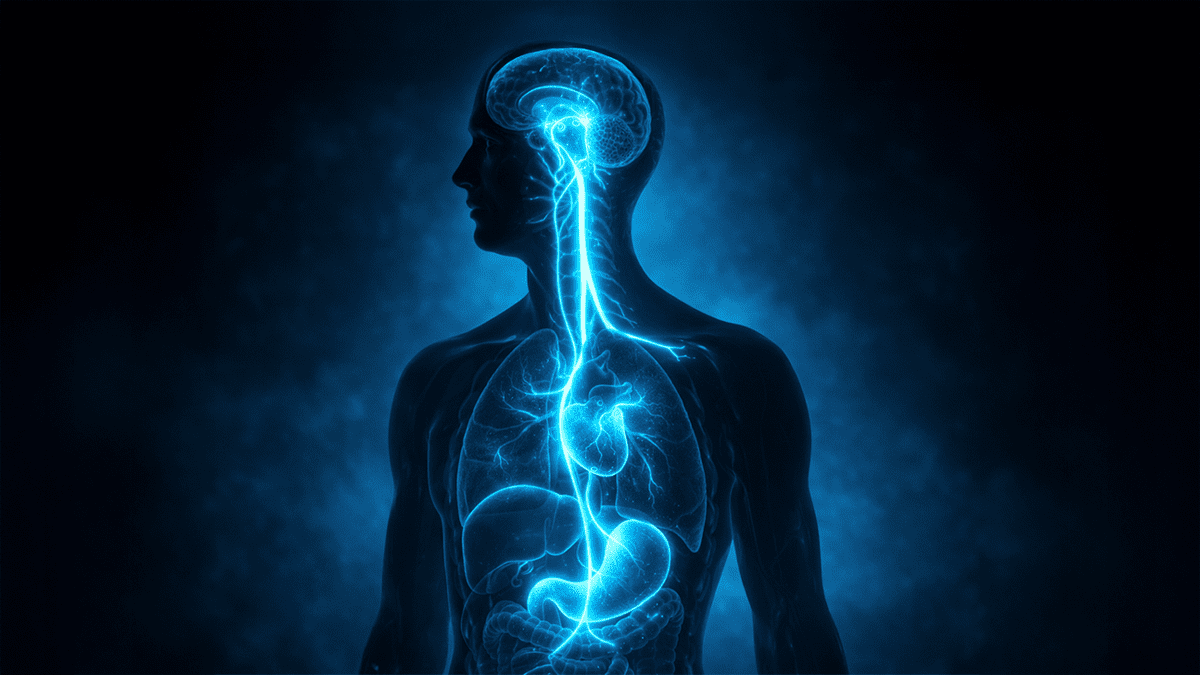
It sounds like science fiction, but it is real biology. It’s called the Vagus Nerve.
For years, scientists ignored it. Now, Silicon Valley tech bros, top-tier athletes, and wellness influencers are obsessed with it. Why? Because learning to control this one nerve can lower your anxiety, fix your digestion, and help you sleep like a baby—without taking a single pill.
Here is everything you need to know about the “Body’s Superhighway,” explained in plain English.
Why You Can’t Just “Calm Down”
Have you ever told someone who is panicking to “just relax”? Did it work?
Of course not.
That’s because stress isn’t just in your head—it is in your body. When you get an annoying email or see a scary news headline, your body thinks you are being chased by a tiger.
This is your “Fight or Flight” mode.
- Your heart beats faster.
- Your digestion stops (leading to stomach aches).
- Your breathing gets shallow.
The problem is, in the modern world, the “tiger” never goes away. The emails keep coming. The bills keep piling up. So, your body gets stuck in “Fight” mode for years.
This is where the Vagus Nerve comes in.
Think of the Vagus Nerve as the brake pedal of your car. If “Fight or Flight” is the gas pedal that speeds you up, the Vagus Nerve is the only thing that slows you down.
When you hit the brake (activate the nerve), your body instantly enters “Rest and Digest” mode.
- Your heart rate drops.
- Your shoulders drop.
- Your stomach starts working again.
- You feel… safe.
The goal of this article isn’t to teach you anatomy. It is to teach you how to stomp on that brake pedal whenever you want.
The “Ice Water” Trick (The Instant Hack)
Let’s skip the theory and get straight to the hacks. This is the most famous trick in the biohacking world, and it costs exactly ₹0.
It is called the “Dive Reflex.”
Have you ever jumped into a cold pool and felt your breath catch? That wasn’t just shock—that was your Vagus Nerve waking up.
When cold water hits the area around your eyes and nose, your brain thinks: “We are underwater! Conserve oxygen! Slow the heart down!”
How to do it at home (without a pool):
You don’t need a fancy ice bath.
- Fill a bowl with cold water and throw in some ice cubes.
- Take a deep breath.
- Dunk your face in the water for 10 to 20 seconds.
That’s it.
When you pull your head up, you will feel a wash of calm over your body. It is physiological. It is impossible not to feel it.
Why do this?
If you are having a panic attack, a migraine, or just a really bad day at work, this is the “Emergency Stop” button. It resets your nervous system in 30 seconds.
The “Magic” of Breathing (The Slow Exhale)
If the idea of dunking your head in a tub of ice water sounds like something only the most hardcore of Tuesday morning warriors would do, don’t worry. There’s a simpler way. You’re already doing it.
Breathing.
But chances are, you’re breathing all wrong. When we’re stressed, we’re taking quick shallow breaths high in our chest. This actually tells our brain to keep freaking out. To hack the Vagus Nerve, you have to alter the Ratio.
The 4-7-8 Technique
This isn’t just some yoga nonsense; this is math for your nervous system.
- Breathe in through your nose for a count of 4.
- Hold your breath for a count of 7.
- Slowly exhale through your mouth (as if you’re blowing through a straw) for a count of 8.
The Secret Sauce:
The trick is in the Exhale.
When you breathe in, your heart rate goes up a little bit. When you breathe out, your heart rate goes down. By exhaling twice as long as you breathe in, you’re literally forcing your heart rate to slow down. Do this right now, while you’re reading this. Do it three times.
Notice that slight relaxation in your jaw? That’s your Vagus Nerve kicking in.
The Tech Revolution (Stress-Canceling Wearables)
Alright, so we have ice and we have breathing. But this is 2026. We have technology for everything.
Tech giants have understood that people are too stressed to meditate. So, they created something that can cancel out stress for you. And this is a multibillion-dollar industry.
The “Vibrating” Wristbands
The Apollo Neuro is a device that looks like an Apple Watch without the screen. Instead of showing you notifications (which are stress-causing), they rest on your wrist and vibrate. But they don’t just vibrate randomly. They vibrate in a particular pattern that simulates the sensation of human touch—like a hug or holding hands.
Your brain registers this vibration on your skin and goes, “Oh, someone is hugging me. I am safe.” It sounds crazy, but clinical trials have proven that it actually helps you focus and reduces heart rate.
The Ear Clips (Electronic Medicine)
This is the serious business. The NuroSym device clips onto your ear. Why the ear? Because the Vagus Nerve actually makes an appearance right inside your ear (specifically, the ridge above your ear canal). This device sends a small, painless electrical impulse through the skin and directly into the nerve.
Does it hurt? No, it’s just a tiny little zing.
Does it work? The results are staggering. People use these for 15 minutes a day to alleviate “Long COVID,” chronic fatigue, and burnout. It is literally a pacemaker for your stress.
Your Gut is Your Second Brain
Have you ever had a “gut feeling”? Or felt “butterflies” in your stomach before a date? That isn’t a metaphor. That is your Vagus Nerve talking
The nerve links your brain directly to your stomach. This is why you get diarrhea when you are nervous, or lose your appetite when you are sad. But here is the crazy part:
It works both ways. If your gut is unhappy, your brain will be unhappy. Scientists have found that people with anxiety and depression have different gut bacteria than people who are happy.
The “Happy” Bacteria In 2026, we aren’t just taking probiotics for bloating anymore. We are taking them for mental health. These are called “Psychobiotics. If you eat a lot of sugar, processed foods, and seed oils, you are feeding the “bad” bacteria. These bad guys send inflammation signals up the Vagus Nerve to your brain, where you get brain fog and anxiety.
If you eat fermented foods (like Yogurt, Kimchi, Sauerkraut) or take special fiber supplements, you are feeding the “good” bacteria. They make Serotonin (the happy chemical) and send it up the Vagus Nerve to your brain.
The Lesson: You cannot think your way out of a bad diet. Sometimes, the answer to your anxiety is on your dinner plate, not in your head.
The “Humming” Trick (Using Your Own Voice)
Here’s a strange but true fact: The Vagus Nerve runs directly through your vocal cords.
This is why people in yoga chant “Om” and why loud hymns in church make people feel so calm. It’s not just spiritual, it’s physical. When you hum or sing, the sound waves in your throat physically stimulate the nerve.
Try this “Vocal Reset”:
- Close your eyes.
- Breathe deeply.
- Hum a low, humming “Mmmmmm” sound until your lungs are empty.
- Pay attention to the sensation in your chest and throat.
Do this 5 times.
It’s ridiculous, but it immediately lowers your heart rate. Next time you’re stuck in traffic and feeling the road rage, just hum.
The 7-Day “Nervous System” Reset Plan
You don’t have to do it all at once. Start small. Here’s a simple plan to retrain your body to relax.
- Monday (Cold Water): Finish your morning shower with 30 seconds of cold water. Scream if you have to.
- Tuesday (The Exhale): Set a timer for 11:00 AM. Do the “4-7-8 Breathing” for just 2 minutes at your desk.
- Wednesday (Gut Health): Eat one serving of yogurt, kefir, or kimchi with lunch. Feed the good bacteria.
- Thursday (Digital Detox): No phone for the first 30 minutes after waking up. Let your cortisol levels settle naturally.
- Friday (The Hum): Hum along to your favorite song in the car or shower. loudly.
- Saturday (Nature Walk): Take a 20-minute walk outside with your eyes open and without headphones. Notice the horizon (use panoramic vision to calm your brain).
- Sunday (Rest): Do nothing for 1 hour. No TV, no phone, no work. Just exist.
Frequently Asked Questions (FAQs)
Q: How do I know if my Vagus Nerve is damaged?
A: You can’t really “damage” it like a broken bone, but it can have “low tone.” Symptoms include persistent anxiety, swallowing problems, constant inflammation, or passing out easily (vasovagal syncope).
Q: How long does it take to strengthen the Vagus Nerve?
A: Like going to the gym, consistency is more important than intensity. Most people notice an immediate benefit from cold water therapy, but actual changes in anxiety typically take 4-8 weeks of daily practice.
Q: Can Vagus Nerve stimulation help with weight loss?
A: Indirectly, yes. When you’re stressed (Fight or Flight), your body stores fat and wants sugar for energy. By stimulating the Vagus Nerve (Rest and Digest), you reduce cortisol production, making it easier to shed pounds.
Q: Are Vagus Nerve devices safe?
A: Most commercial devices (vibration bands or ear clips) are extremely safe. But if you have a pacemaker or heart problems, always check with your doctor before using electrical stimulation devices.
Take Back Control
We live in a loud, fast, and stressful world. The notifications won’t stop. The traffic won’t vanish. The bills will keep coming. You can’t control the world around you, but you can control how your body responds to it.
The Vagus Nerve is your superpower. It is the remote control for your biology. You don’t need an expensive pill or a trip to the Himalayas to find your peace. You just need a splash of cold water, a few deep breaths, and the will to press the “Pause” button.
So, take a deep breath. Exhale slowly.
You are in control.