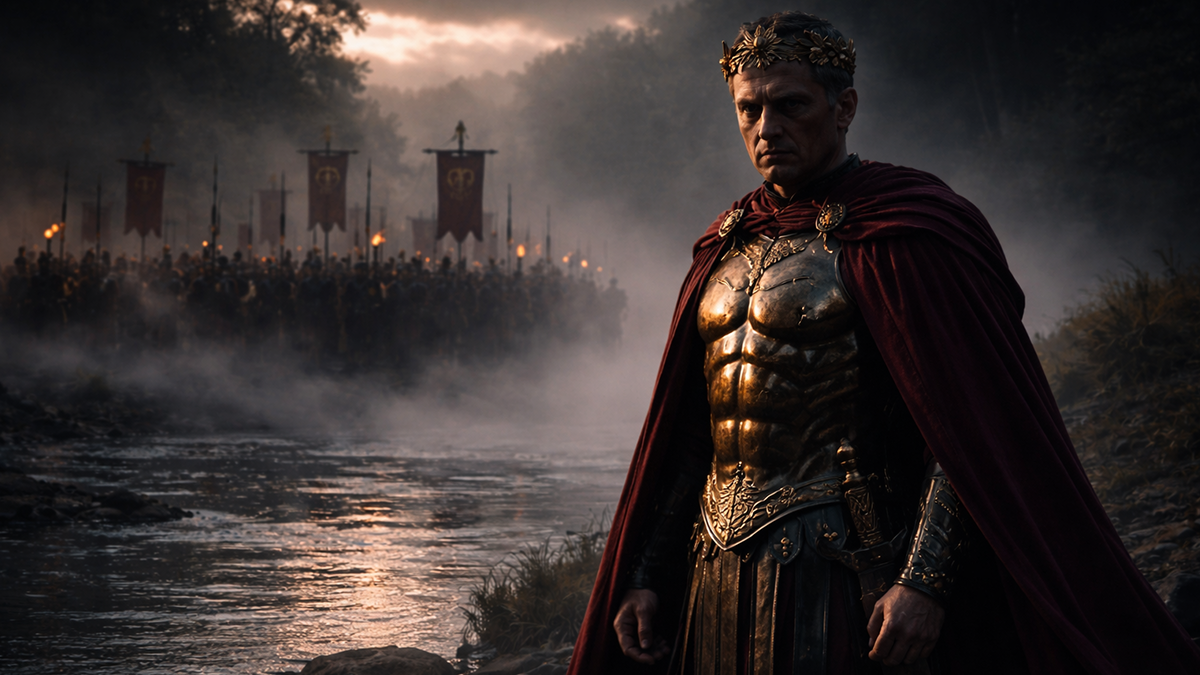
Imagine you are a young Roman aristocrat, recently kidnapped by pirates in the Mediterranean. Most people in your position would be trembling, praying to the gods, and begging for mercy.
Not Julius Caesar.
When the pirates demanded twenty talents of silver for his release, Caesar laughed in their faces. He told them they clearly didn’t know who they had captured and insisted they ask for fifty. While he was their prisoner, he didn’t act like a captive; he acted like their boss. He wrote poems, read them to the pirates, and told them that once he was free, he would return and crucify every single one of them. The pirates thought he was joking.
He wasn’t. The moment the ransom was paid, Caesar raised a private navy, hunted them down, and did exactly what he promised.
This story isn’t just about revenge. It is the perfect introduction to the Julius Caesar Strategy. Caesar understood that power isn’t just about how many soldiers you have; it’s about the narrative you project. He lived his life as a high-stakes performance, and in doing so, he became the most famous historical personality to ever walk the earth. Here is how he manipulated the world to his will.
The Point of No Return: The Psychology of the Rubicon
Every great leader eventually faces a “Rubicon” moment—a decision that is impossible to take back. For Caesar, this was literal.
The Roman Senate, terrified of his growing popularity and military power, ordered him to lay down his command and return to Rome as a private citizen. If he obeyed, his enemies would destroy him. If he disobeyed and crossed the Rubicon river with his army, he would be declared an enemy of the state. It was civil war or certain death.
The Strategy of Finality
Caesar didn’t hesitate. He uttered the famous words “Alea iacta est” (The die is cast) and marched. This is a core pillar of the Julius Caesar Strategy: Decisiveness.
In the modern world, we often suffer from “Analysis Paralysis” (like the OTT Fatigue we talked about). We wait for the “perfect” moment. Caesar knew that perfection is a myth. He understood that once a decision is made, the only way forward is total commitment. By crossing that river, he eliminated his own safety net. He forced himself and his men into a situation where the only options were total victory or total destruction. That level of focus is a superpower.
Veni, Vidi, Vici: The Invention of the Viral Catchphrase
Caesar was perhaps the first human being to understand “Vibe Marketing.” He knew that the people back in Rome didn’t want to read a 50-page dry report about a military campaign in Asia Minor. They wanted a headline.
When he defeated Pharnaces II in a lightning-fast war, his report to the Senate consisted of only three words: “Veni, Vidi, Vici” (I came, I saw, I conquered).
The Power of Simplicity
This wasn’t just arrogance; it was brilliant branding. He reduced a complex military operation into a punchy, unforgettable slogan. He knew that if you control the language, you control the perception of reality.
In an age where our attention spans are rotting from short-form content, the Julius Caesar Strategy of extreme brevity is more relevant than ever. He communicated his competence so efficiently that his name, “Caesar,” eventually became the title for emperors for the next two thousand years (think Kaiser in Germany or Tsar in Russia). He didn’t just win the war; he won the dictionary.
The Populist Playbook: Connecting with the “Common Man”
The Roman Republic was an oligarchy—a group of old, wealthy men making decisions for everyone else. Caesar realized that if he wanted to topple the system, he needed the support of the people the system ignored: the Populares.
Building the Social Moat
Caesar spent money he didn’t even have to put on massive public games and feasts. He advocated for land reform and debt relief. He made sure the average Roman citizen felt that Caesar was “one of them,” even though he was an aristocrat.
This is the “Experience over Excess” trend we discussed, applied to 44 BC. He gave the people an experience of inclusion. He used his personal charisma to bypass the traditional media (the Senate) and talk directly to the masses. This “Direct-to-Consumer” approach to politics made him untouchable. Even when the elites hated him, the street would have burned for him.
Forging the Legend: The Descent from the Gods
To understand the full scope of the Julius Caesar Strategy, you have to look at how he handled his own “Pre-History.”
Caesar claimed that his family, the Julii, were direct descendants of Iulus, the son of the Trojan prince Aeneas, who was the son of the goddess Venus. By linking himself to the divine, he wasn’t just a politician; he was a destiny.
In today’s branding terms, this is “Origin Story” optimization. He created a mythic background that made his rise seem inevitable. When people believe you are destined for greatness, they stop trying to block your path and start trying to join your team. He turned his life into a “Tapestry-free” story of inevitable triumph.
The Fatal Flaw: The Danger of Being the Only “Agent”
If Caesar was so smart, why did he end up bleeding on the floor of the Senate?
The Julius Caesar Strategy had one massive blind spot: The “I” Factor. Caesar became so successful as a “one-person company” (like the AI trends we covered) that he forgot to manage the egos of his “middle management.”
He accepted the title of “Dictator in Perpetuity.” He wore purple robes (the color of kings). He sat on a golden throne while others stood. He became so focused on the “Vibe” of his own greatness that he stopped noticing the resentment brewing in the shadows.
The lesson for any modern leader is clear: You can win the crowd and you can win the war, but if you don’t share the credit and respect the institutions you’ve outgrown, those institutions will eventually conspire to pull you down.
Frequently Asked Questions (FAQs)
Q: Was Julius Caesar actually the first Emperor of Rome?
A: Technically, no. He was a Dictator. His great-nephew, Augustus (Octavian), became the first official Emperor. However, Caesar laid all the groundwork. Without the Julius Caesar Strategy, the Roman Empire would never have existed.
Q: Why do we still care about Caesar today?
A: Because he is the blueprint for the “Disruptor.” He looked at a 500-year-old institution (the Republic) and realized it was broken. He had the courage to break it further and build something new. Whether you agree with him or not, his impact on Western law, language, and government is permanent.
Q: Did Caesar really write his own history books?
A: Yes. His Commentaries on the Gallic War are masterpieces of self-promotion. He wrote about himself in the third person (“Caesar did this,” “Caesar moved there”) to make his actions seem objective and heroic. It was the ultimate “Content Marketing” move.
Q: What can a student or professional learn from him?
A: The importance of “Narrative Control.” It doesn’t matter how hard you work if nobody knows what you’ve achieved. Learning to tell your story, simply and powerfully, is the difference between a worker and a leader.
The Ghost of the Capitol
Julius Caesar died over two thousand years ago, but he is still in the room with us. He is in our calendars (the month of July is named after him). He is in our surgery rooms (the Caesarean section). He is in our political debates.
The Julius Caesar Strategy proves that a person’s reach isn’t limited by their lifespan. If you build a powerful enough narrative, if you take calculated risks, and if you understand the psychology of the people you serve, you can become an “Evergreen” force.
Be decisive. Keep it simple. Know your “Rubicon.” Just remember to watch your back.