Remember 2023?
You would open ChatGPT and say, “Write me an email to my boss asking for a raise.”
It would write the email. Then you had to copy it, paste it into Gmail, hit send, and wait for the anxiety to kick in.
That was “Generative AI.” It created things for you.
Welcome to 2026.
Now, you look at your Apple HomePod or Google Gemini Hub and say: “Get me a raise.”
The AI analyzes your performance data, drafts the email, schedules a meeting with your boss, and puts a reminder on your calendar. You didn’t touch a keyboard.
This is “Agentic AI.” It doesn’t just create; it acts.
In the United States, 2026 is already being hailed as “The Year of the Agent.” People are deleting apps. They are ignoring websites. They are handing over their digital keys to an AI and saying, “You handle it.”
Here is why the “App Store” model is dying, and why your next gadget won’t be a phone—it will be a Butler.
What is an AI Agent? (The “Doer” vs. The “Talker”)
To understand the hype, you need to understand the difference between a Chatbot and an Agent.
- The Chatbot (The Intern):
- You: “Find me a flight to New York for under $500.”
- Bot: “Here is a list of flights. You can book them on Expedia.”
- Result: You still have to do the work.
- The AI Agent (The Executive Assistant):
- You: “Get me to New York next Friday. Use my miles if possible.”
- Agent: “Done. I booked United Flight 402 using your Chase points. I also reserved an Uber to the airport for 6:00 AM and ordered your usual vegetarian meal.”
- Result: You didn’t open a single app.
The Hardware Shift
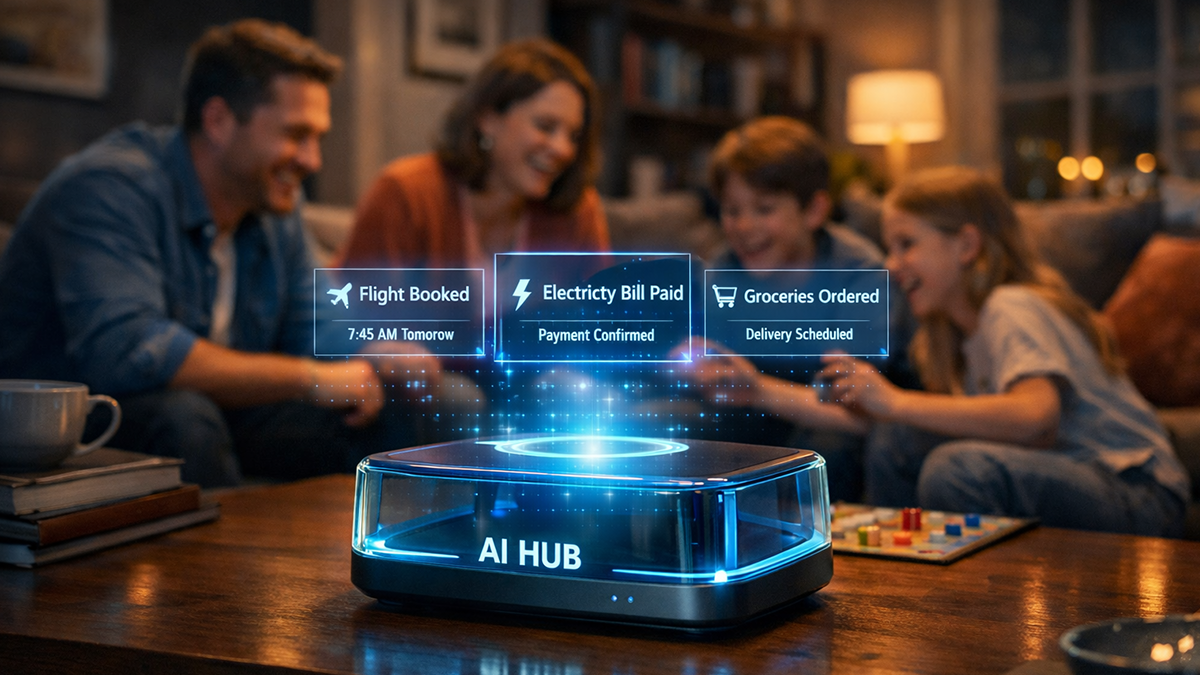
In US households, the center of gravity has shifted from the Smartphone to the “Agent Hub.”
Devices like the new Apple HomePod Vision or the Google Nest Gemini are no longer just speakers. They are secure servers that hold your credit card info, your passwords, and your preferences. They are the brain of the house.
The “Killer” Use Cases (What Are They Actually Doing?)
Americans aren’t using these agents to write poetry. They are using them to do the boring, soul-sucking tasks that humans hate.
1. The Bill Negotiator
This is the #1 use case in 2026.
- The Problem: Cable companies (like Comcast in the US or Jio/Airtel in India) rely on you being too lazy to call and negotiate a better rate.
- The Agent Fix: You tell your Agent, “My internet bill is too high.”
- The AI calls customer service.
- It waits on hold (so you don’t have to).
- It talks to the human rep (using a synthesized voice).
- It threatens to cancel service unless they lower the price.
- Result: It texts you: “I lowered your bill by $20/month. You’re welcome.”
2. The Vacation Planner
Planning a family trip usually involves 50 tabs open: Flights, Hotels, Car Rentals, Dinner Reservations.
- The Agent Fix:“Plan a 5-day trip to Hawaii for a family of 4. Budget is $5,000. No red-eye flights. We need a pool.”
- The Agent scans thousands of combinations.
- It books the flights.
- It reserves the Airbnb.
- It even emails your boss to block your calendar.
- Click -> Done.
3. The Energy Broker (Smart Grid)
In states like California or Texas (and soon in India), electricity prices change every hour based on demand.
- The Agent Fix: Your Home Hub connects to your Solar Panels and your EV Charger.
- It sells electricity back to the grid when prices are high (making you money).
- It charges your Tesla/Nexon when prices are negative (free energy).
- It does this 24/7, making micro-trades that save the average household $1,500 (₹1.2 Lakhs) a year.
The Death of the “App”
This is bad news for App Developers.
If I have an AI Agent, why do I need to open the Uber app? Why do I need to open Zomato? Why do I need to open Expedia?
I don’t.
I just talk to my Agent. The Agent talks to Uber’s API (Application Programming Interface).
The “App” becomes invisible. It’s just plumbing.
The “Super-App” War
This is why Apple, Google, and Meta are fighting.
- If Apple Intelligence becomes your Agent, Apple controls everything you buy.
- If Meta AI becomes your Agent (via WhatsApp), Meta controls your life.
The company that owns the Agent owns the customer. The individual apps are just suppliers.
The Trust Gap (Would You Give AI Your Credit Card?)
This is the billion-dollar hurdle.
For an Agent to work, it needs Permission.
- It needs your credit card number.
- It needs your email password.
- It needs your ID.
In 2026, the US market solved this with “On-Device Processing.”
- Apple’s Pitch: “The AI runs on your HomePod. Your data never goes to the cloud.”
- Google’s Pitch: “We use a ‘Secure Enclave’ chip that even we can’t access.”
The “Hallucination” Risk
What if the AI hallucinates and books a flight to Austria instead of Australia?
Currently, Agents operate on a “Human-in-the-Loop” model.
- The AI does the work.
- It presents a final summary: “I am about to spend $4,000. Confirm?”
- You press “Yes.” It never spends without that final click
When is this Coming to India?
India is skipping the “PC Era” and went straight to Mobile.
Experts predict India will skip the “App Era” and go straight to Agents.
Why India is Perfect for Agents:
- Language Barrier: Typing in English is hard for millions. Speaking to an Agent in Hindi, Tamil, or Telugu is easy.
- UPI Integration: India has the best payment infrastructure in the world. An AI Agent connected to UPI is a superpower. Imagine an AI that pays your electricity bill, recharges your FastTag, and settles your credit card bill automatically.
- The “Jugaad” Factor: Indians love a bargain. An AI Agent that constantly scans Flipkart and Amazon to buy your wishlist items only when the price drops? That will be a massive hit.
Timeline:
Expect Jio or Tata Neu to launch the first “Indian Super Agent” by late 2026.
Frequently Asked Questions (FAQs)
Q: Are AI Agents expensive?
A: The hardware hub costs around $300 (Rs. 25000) because running these “Agentic” models requires massive computing power.
Q: Can an Agent steal my money?
A: Theoretically, yes. That is why you should set Spending Limits (e.g., “Never spend more than ₹5,000 without my FaceID”). Never give an AI unlimited access to your main bank account.
Q: Will this replace human Personal Assistants?
A: For scheduling and booking? Yes. For emotional support and complex creative tasks? No. But the role of the “Secretary” is effectively dead.
The Ultimate Luxury is Time
For the last 15 years, technology made us busy.
We spent hours scrolling, clicking, updating, and managing our digital lives. We became the administrators of our own phones.
AI Agents promise to give us that time back.
The “hottest” gadget of 2026 isn’t a screen you look at. It’s a voice you talk to—so you can go back to looking at your family.
The software is finally doing what it was always supposed to do: Work for us.