Hey, look up at the moon tonight. For most of human history, that glowing rock was just a poetic symbol or a calendar. In the 1960s, it was a finish line for two superpowers trying to prove who had the bigger ego.
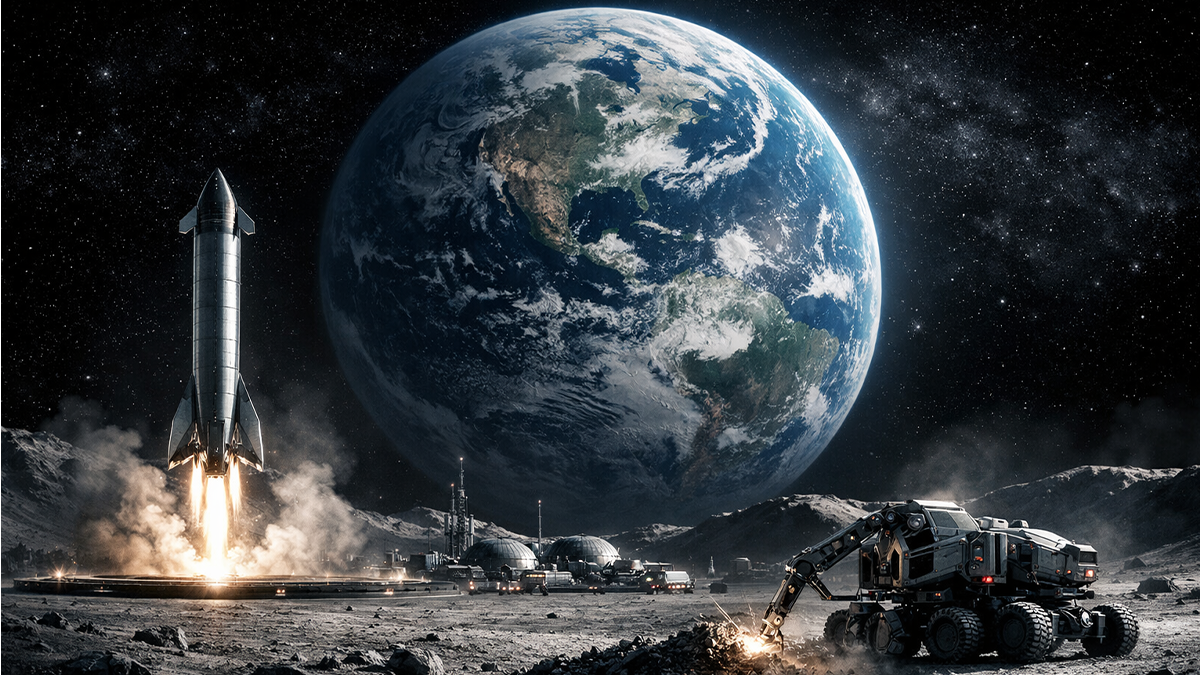
But in March 2026, the moon is something else entirely. It’s a construction site.
Welcome to the New Space Race.
This isn’t your grandfather’s space race. The old one was about flags and footprints. This one is about factories, fuel, and massive profits. We have moved from a world where only governments could afford to launch a satellite to a world where a billionaire can launch a sports car into orbit just for the “vibes.”
Space is no longer science fiction. It is the next trillion-dollar industry. Here is why the race to the stars has gone private, why the Moon is the new Silicon Valley, and what all of this actually means for your life back here on Earth.
What is it? (The Great Pivot to Private)
The original space race was a battle between the USA and the USSR. It was fueled by taxpayer money and national pride. When the Soviet Union collapsed, the race slowed down to a crawl. For decades, we were stuck in “Low Earth Orbit,” just circling the planet on the International Space Station.
The New Space Race is different because the engine is Capitalism.
The Reusable Revolution
The turning point was the “Reusable Rocket.” Before Elon Musk and SpaceX, every rocket was a ₹500 Crore firework that was used once and thrown into the ocean. It was like flying a Boeing 747 from Hyderabad to London and then crashing the plane into the Atlantic.
By landing rockets vertically, SpaceX slashed the cost of reaching space by 90%. Suddenly, space wasn’t just for NASA; it was for anyone with a business plan.
The Players
- SpaceX: The undisputed leader, aiming to make humans a multi-planetary species.
- Blue Origin: Jeff Bezos’s venture, focused on moving heavy industry off Earth to save our environment.
- NASA (Artemis): The “anchor client” that provides the framework for the return to the Moon.
- ISRO (India): The “Value King” of space, proving that you can reach the Moon and Mars on a budget that costs less than a Hollywood movie.
The Moon – Our New Eighth Continent
In 2026, the Moon is the primary target. But we aren’t going there to visit; we are going there to stay.
NASA’s Artemis Mission
The Artemis program is the backbone of the New Space Race. Unlike the Apollo missions, which were “camping trips,” Artemis is about building a permanent base. By late 2026, we expect to see the first elements of the Lunar Gateway—a space station that orbits the Moon, acting as a pit stop for astronauts.
Why the Moon?
It’s not just a rock. It’s a resource.
- Water Ice: Discovered at the lunar poles, this is the “Oil” of the 21st century. Water can be broken down into Hydrogen and Oxygen to make Rocket Fuel.
- Helium-3: A rare isotope that could power clean, nuclear fusion energy for Earth for thousands of years.
- The Launchpad: Because the Moon has 1/6th of Earth’s gravity, it is much easier and cheaper to launch deep-space missions to Mars from the Moon than from Earth.
What Does It Do For Me? (Space Tech in Your Pocket)
You might think, “Dev, why should I care about a lunar base when my WiFi is slow?”
The irony is that the New Space Race is the reason your WiFi will eventually be fast everywhere.
1. Global Connectivity (Starlink & Beyond)
The most immediate “Product” of this race is the satellite mega-constellation. SpaceX’s Starlink and Amazon’s Project Kuiper are launching thousands of tiny satellites. This is ending the “Digital Divide.” Whether you are in the middle of the Sahara Desert or a remote village in the Himalayas, you now have high-speed internet.
2. The Medical Frontier
Experiments in “Microgravity” (zero-G) are revealing medical secrets that are impossible to find on Earth. In space, protein crystals grow perfectly, and stem cells behave differently. Pharmaceutical companies are already planning “Orbital Labs” to manufacture cancer drugs and 3D-print human organs that the Earth’s gravity would normally collapse.
3. Climate Monitoring
The New Space Race has given us “Eyes in the Sky” that never blink. New high-res satellites can now track methane leaks in real-time and predict forest fires days before they start. We are using space to save Earth.
The Trillion-Dollar Economy (Mining & Tourism)
This is where the “Trillion” comes from. Goldman Sachs has predicted that the first trillionaire will be someone who mines an asteroid.
Asteroid Mining
There are “Near-Earth Asteroids” that contain more Platinum, Gold, and Cobalt than has ever been mined in human history. One single asteroid, 16 Psyche, is estimated to hold metals worth $10,000 quadrillion.
In 2026, start-ups are already testing “prospecting drones” to see which asteroids are easiest to grab. If we can bring these materials back, the cost of electronics (which rely on rare metals) could crash, making tech affordable for everyone.
Space Tourism
It started with ₹2 Crore tickets for a 10-minute “hop” to the edge of space. But in 2026, we are seeing the rise of Orbital Hotels. Companies like Axiom Space are attaching luxury modules to the ISS. Within the next decade, “The Trip of a Lifetime” won’t be Paris; it will be a 3-day stay with a view of the entire planet.
How Do I Use It? (Participating in the Race)
You don’t have to be an astronaut to join the New Space Race.
- Investing: While SpaceX is private, many of its suppliers and competitors are public. Look into “Space ETFs” or aerospace companies that are building the hardware for the lunar economy.
- Careers: We don’t just need rocket scientists. We need space lawyers (to figure out who owns the Moon), space architects, space doctors, and data analysts.
- Education: If you have kids, encourage “STEM” but with an “Interdisciplinary” twist. The space economy needs people who understand both biology and engineering.
Frequently Asked Questions (FAQs)
Q: Is the New Space Race making space junk a problem?
A: Yes. Low Earth Orbit is becoming crowded. However, the 2026 trend is “Active Debris Removal.” Companies are now being hired to “harpoon” or “net” old satellites to clear the lanes for new missions.
Q: When will the common man go to the Moon?
A: “Common” is a relative term. For the next 10 years, it will remain a destination for researchers and the ultra-wealthy. But remember, 100 years ago, flying in an airplane was a luxury for kings. Now, it’s a bus in the sky. Space will follow the same curve.
Q: Is India a big player in this?
A: Absolutely. India’s Gaganyaan mission and the success of Chandrayaan-3 have made ISRO a global heavyweight. India is currently the preferred partner for countries that want to launch satellites reliably and cheaply.
We Are a Multi-Planetary Species Now
The New Space Race is the ultimate proof of human ambition. We have spent thousands of years looking up at the stars and wondering. Now, we are finally reaching out and touching them.
This isn’t about escaping Earth because we messed it up. It’s about expanding our horizon because we’ve outgrown our cradle. Space offers us infinite energy, infinite resources, and an infinite future.
The trillion-dollar economy isn’t coming; it’s already here. The countdown has finished. The engines are roaring.
Are you coming along for the ride?