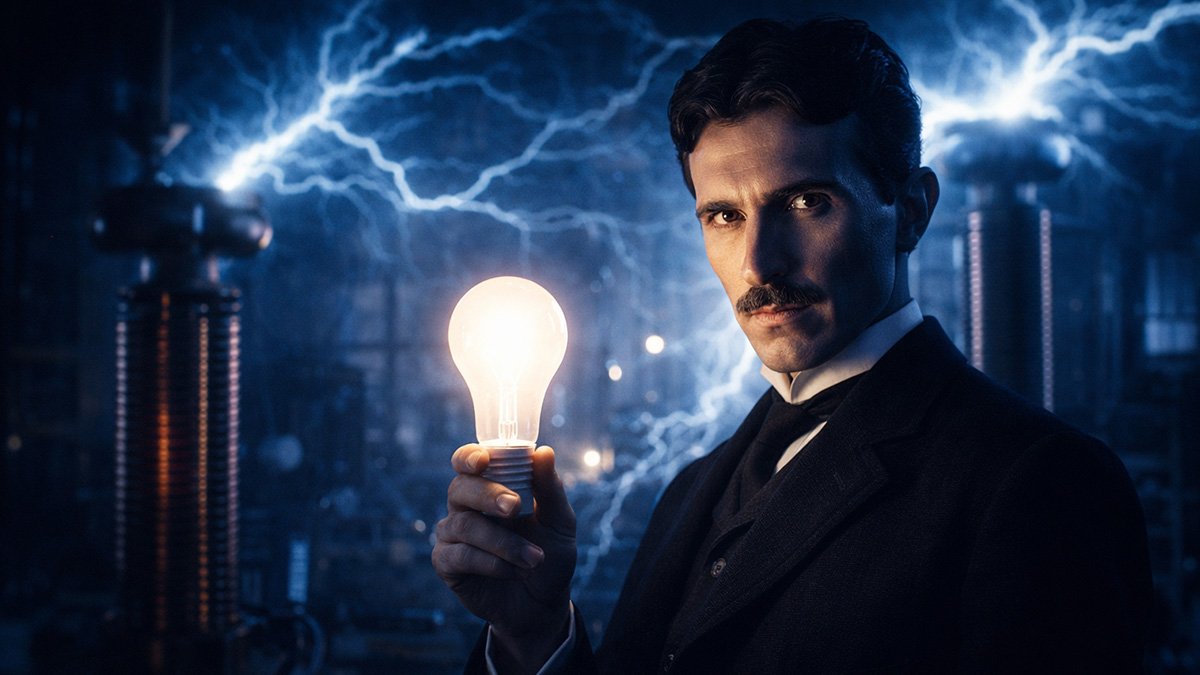
If you were to walk down the street in New York City in the late 1890s, you might have spotted a tall, slender man with piercing eyes and a perfectly groomed mustache. He lived in a hotel, spoke eight languages, and claimed he could talk to Martians. Most people dismissed him as a madman. Others saw him as a wizard.
Today, every time you flip a light switch, charge your smartphone, or use a remote control, you are using the brain of that “madman.”
Nikola Tesla is perhaps the most fascinating figure among all famous historical personalities. While history books often give the credit to Thomas Edison for the “Electric Age,” the reality is that Edison gave us the lightbulb, but Tesla gave us the world that powers it. He was a man who lived a century ahead of his time—a visionary who saw the earth as a giant electrical circuit and dreamed of giving free energy to every human being on the planet.
But why did the man who literally invented the 20th century die alone in a hotel room with nothing but pigeons for company? To understand the modern world, you have to understand the genius, the greed, and the tragic fall of Nikola Tesla.
The Man Who Invented the Modern World
Nikola Tesla didn’t just “invent” things; he envisioned systems. Born during a fierce lightning storm in modern-day Croatia, it was as if the universe had already chosen his path. He arrived in America with nothing but four cents in his pocket and a letter of recommendation to Thomas Edison.
The relationship between Tesla and Edison is one of the greatest rivalries in the history of science. Edison was a businessman; he believed in “Direct Current” (DC), which was expensive and could only travel short distances. Tesla saw the flaw. He championed “Alternating Current” (AC), which was safer, cheaper, and could power entire cities.
This sparked the “War of Currents.” Edison, desperate to protect his patents, went to extreme lengths to discredit Tesla, even publicly electrocuting animals to show that AC was “dangerous.” But logic won. Tesla’s AC system powered the Chicago World’s Fair and eventually the Niagara Falls power plant, effectively lighting up the entire world. If you are reading this on a powered device right now, you are a guest in Tesla’s house.
The Wireless Dream: A Century Before Wi-Fi
What makes Tesla stand out among other famous historical personalities is that his mind didn’t stop at electricity. He was obsessed with the idea of “Wireless Energy.”
Long before we had Bluetooth, Wi-Fi, or cell phones, Tesla was building a massive tower called Wardenclyffe in Long Island. His goal was to transmit not just information, but actual electrical power through the air, using the Earth’s ionosphere. He wanted a world where a farmer in a remote village could stick a rod in the ground and pull out free electricity to power his home.
He called it the “World Wireless System.” To the bankers of the time, this was a nightmare. If energy was free and wireless, they couldn’t put a meter on it. They couldn’t charge people for it. The funding for Tesla’s dream was cut, the tower was demolished for scrap metal, and the most ambitious project in human history was buried under the rug of corporate greed. We are only now, a hundred years later, beginning to catch up to the wireless world Tesla already saw in his dreams.
Adopting the Tesla Mindset: How to Think Like a Maverick
You might think that studying famous historical personalities is just for trivia, but Tesla’s life offers a blueprint for the “Total Creator.” He didn’t work like other inventors. He didn’t use trial and error.
Tesla had a superpower: Visual Engineering.
He claimed he could build a machine entirely in his mind, “run” it for weeks to see where the parts would wear down, and then build the physical version perfectly on the first try. He used “Deep Focus” (the original Monk Mode) to inhabit his mental laboratory.
In our world of constant distractions and “Brain Rot,” the Tesla mindset is more valuable than ever. He teaches us that the highest form of work isn’t “doing”—it’s “thinking.” He prioritized the vision over the reward. He wasn’t interested in being a billionaire; he was interested in being a pioneer. For any modern professional, the lesson is clear: If you want to change the world, you have to be willing to look like a madman to the people who are only interested in the status quo.
The Tragic Price of Genius
The reason Tesla is often forgotten in the list of famous historical personalities is that he was a terrible businessman. He tore up a contract with George Westinghouse that would have made him the world’s first billionaire—simply because he wanted to help his friend’s company survive.
He spent his final years obsessed with eccentric ideas—a “Death Ray” that would end all wars, and a method for photographing thoughts. He became a recluse, talking to pigeons and developing an intense germaphobia.
When he died in 1943, the FBI immediately seized his trunks of research. They were terrified that his “Death Ray” or his wireless energy secrets would fall into the wrong hands. For decades, his name was scrubbed from the history of the radio (which he invented, not Marconi) and the induction motor. He became a ghost in the machine he built.
Frequently Asked Questions (FAQs)
Q: Did Nikola Tesla really invent the Radio?
A: Yes. While Guglielmo Marconi is often credited, the U.S. Supreme Court overturned Marconi’s patent in 1943, recognizing that Tesla’s work came first. Tesla’s patents formed the foundational technology for radio transmission.
Q: What is the “Tesla Coil” and do we use it today?
A: The Tesla Coil is a transformer that produces high-voltage, low-current, high-frequency alternating-current electricity. While we don’t use them to power our homes, they were essential in the development of early radio and are still used in various testing and entertainment technologies today.
Q: Why is the electric car company named after him?
A: Elon Musk’s company, Tesla Inc., is named in his honor because the cars use an AC induction motor—a direct descendant of the motor Nikola Tesla patented in 1888. It’s a tribute to the man who pioneered the electric revolution.
Q: Is it true Tesla didn’t sleep?
A: Tesla claimed he followed a “polyphasic” sleep schedule, sleeping only 2 hours a night in short bursts. While this sounds productive, historians believe this contributed to his mental health struggles later in life.
The Ghost in Your Pocket
Nikola Tesla didn’t care that others stole his ideas. He famously said, “I don’t care that they stole my idea… I care that they don’t have any of their own.”
As we navigate our high-tech lives, we are surrounded by his ghosts. He is the grandfather of the smartphone, the father of the drone, and the architect of our electrical grid. Among famous historical personalities, he stands as a reminder that true genius isn’t about what you own, but what you give to the future.
The next time you look at the stars, or simply look at the battery icon on your phone, remember the man who saw the lightning and decided to tame it for all of us. The future didn’t just happen; Nikola Tesla built it.