It is that time of the year again.
The HR department has sent the email: “Please select your Tax Regime for the coming year.”
You are staring at the screen.
- Option A (New Regime): Lower tax rates, but you can’t claim HRA or 80C.
- Option B (Old Regime): Higher tax rates, but you can claim everything under the sun.
Your colleague says, “New is better, it’s simple.”
Your CA uncle says, “Old is gold, stick to investments.”
Who is right?
If you earn ₹10 Lakhs a year, this decision could cost you (or save you) ₹15,000 to ₹30,000. That is the price of a new smartphone or a weekend trip.
Let’s stop guessing and do the actual math. Here is the definitive guide to picking the right regime in 2026.
The “New” Regime (The Default Choice)
In the 2025-26 Budget, the Finance Minister made it clear: The government wants everyone to move to the New Regime. It is now the “Default.”
What is it?
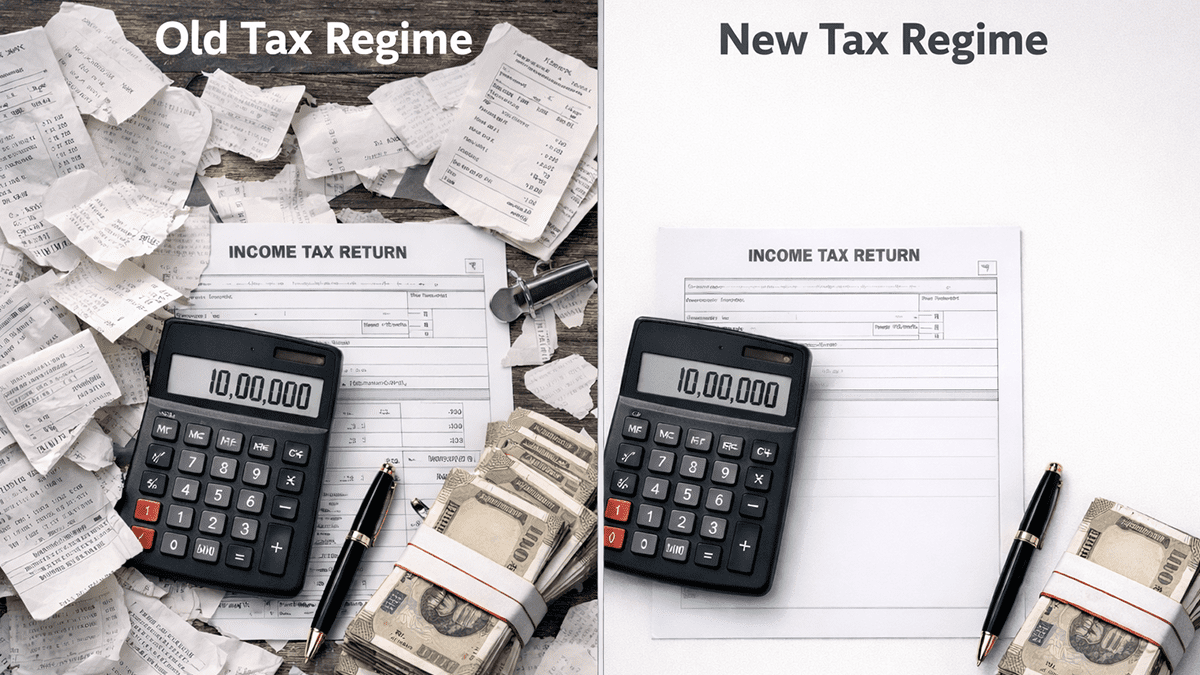
It is a simplified tax structure. You don’t need to submit rent receipts, insurance policies, or tuition fee bills. You just earn money, pay a lower rate of tax, and chill.
The Pros:
- Zero Paperwork: No need to scramble for fake rent receipts or last-minute LIC policies.
- Lower Slab Rates: The tax percentage is significantly lower than the Old Regime.
- Standard Deduction: As of 2026, you get a flat ₹75,000 deduction (increased from ₹50k previously) just for being a salaried employee.
The Cons:
- Goodbye Deductions: You cannot claim Section 80C (PPF/ELSS), 80D (Medical), or HRA (House Rent Allowance).
The Math for ₹10 Lakhs (New Regime)
- Total Income: ₹10,00,000
- Less Standard Deduction: ₹75,000
- Net Taxable Income: ₹9,25,000
- Tax Calculation (Approx):
- 0 – 3L: Nil
- 3L – 7L: 5%
- 7L – 9.25L: 10%
- Total Tax: ~₹45,000 (plus cess).
The “Old” Regime (The Hustler’s Choice)
This is for the “Optimizers.” If you have a home loan, live in a rented house, and invest heavily, the Old Regime fights back.
What is it?
The traditional system where the government rewards you for saving money.
The Deductions (The Big Three):
- Section 80C (Max ₹1.5 Lakh): PF, PPF, ELSS Mutual Funds, Life Insurance.
- Section 80D (Max ₹25k – ₹50k): Health Insurance premiums for self and parents.
- HRA (House Rent Allowance): The biggest tax saver if you live in a metro city and pay rent.
The Math for ₹10 Lakhs (Old Regime)
- Total Income: ₹10,00,000
- Less Standard Deduction: ₹50,000 (It is lower in Old Regime).
- Less 80C: ₹1,50,000 (Assuming you max it out).
- Less 80D: ₹25,000 (Health Insurance).
- Less HRA: Let’s assume you claim ₹1,50,000 (₹12.5k rent/month).
- Net Taxable Income: ₹6,25,000
- Total Tax: ~₹37,500 (plus cess)
The Verdict (Who Wins?)
Wait, did the Old Regime just win?
In the example above, Yes. The Old Regime saved you about ₹7,500.
BUT… look at the effort required.
To save that ₹7,500, you had to:
- Lock away ₹1.5 Lakhs in investments (80C).
- Pay for Health Insurance.
- Pay Rent and submit receipts.
The “Breakeven” Rule (The Cheat Sheet)
Here is the golden rule for a ₹10 Lakh salary in 2026:
Stick to the NEW Regime if:
- Your total deductions (Rent + Investments) are less than ₹2.5 Lakhs.
- You don’t want to lock your money in PPF/Insurance for years.
- You want higher “in-hand” salary every month to invest in stocks/trading.
Switch to the OLD Regime if:
- Your total deductions are more than ₹3 Lakhs.
- You pay significant rent (e.g., ₹15k+ per month in Mumbai/Bangalore).
- You have a Home Loan (Section 24b allows ₹2 Lakh interest deduction).
Which One is Better for “Lifestyle”?
Finance isn’t just math; it’s psychology.
The “New Regime” Lifestyle:
It promotes Spending. Since you aren’t forced to lock money in PPF or Insurance, you have more liquid cash.
- Good for: Young professionals (22-28) who want to travel, buy gadgets, or invest aggressively in high-risk crypto/stocks.
The “Old Regime” Lifestyle:
It promotes Saving. It forces you to be disciplined. You have to buy insurance. You have to put money in PF.
- Good for: Family people (30+) who need financial security and forced savings for the future.
Frequently Asked Questions (FAQs)
Q: Can I switch between regimes every year?
A: Yes! As a salaried employee, you can choose the Old Regime one year and the New Regime the next, depending on your financial situation. (Note: Business owners/Freelancers can only switch once in a lifetime).
Q: Does the ₹7 Lakh tax-free limit apply to the Old Regime?
A: No. The tax rebate under Section 87A (making income up to ₹7 Lakhs tax-free) is primarily a feature of the New Regime. In the Old Regime, the rebate limit is lower (₹5 Lakhs).
Q: Is HRA available in the New Regime?
A: No. HRA is strictly an Old Regime benefit. If you choose New, your rent receipts are useless for tax purposes.
Q: What if I forget to choose?
A: Your employer will automatically put you in the New Regime (Default) and deduct tax accordingly.
The 3.75 Lakh Rule
Don’t overcomplicate it.
Take a calculator. Add up your Rent + 80C + Insurance.
- Is the total > ₹3.75 Lakhs? -> Go OLD.
- Is the total < ₹3.75 Lakhs? -> Go NEW.
For most people earning ₹10 Lakhs in 2026, the New Regime is the winner simply because of the convenience. The tiny saving in the Old Regime usually isn’t worth the paperwork headache.
Pick one, file it, and get back to making money.