If you grew up in India in the 1990s, you didn’t just see a Tata Sierra. You stared at it.
It was the car the cool kids’ dads drove. It had two doors. It had massive glass windows that didn’t roll down (which made no sense, but looked amazing). It was India’s first real lifestyle SUV. And then… it vanished.
Fast forward to February 2026.
Tata Motors has finally brought the legend back. The Sierra is reborn, electric, and looks like it drove straight out of a sci-fi movie.
But nostalgia doesn’t pay the EMI.
Standing in the other corner is Nissan. After surviving on the Magnite for years, they have dropped the Gravite—a 7-seater designed with one goal: To be the most practical “Urban Utility” vehicle on Indian roads.
So, here is the ₹20 Lakh question:
Do you buy the car your Heart wants (Sierra), or the car your Head knows you need (Gravite)?
Let’s drive them back-to-back.
The Design War (Swagger vs. Stealth)
The Tata Sierra: “Look at Me”
The Sierra isn’t a car; it’s a statement.
Tata kept the one thing that mattered: The Glasshouse.
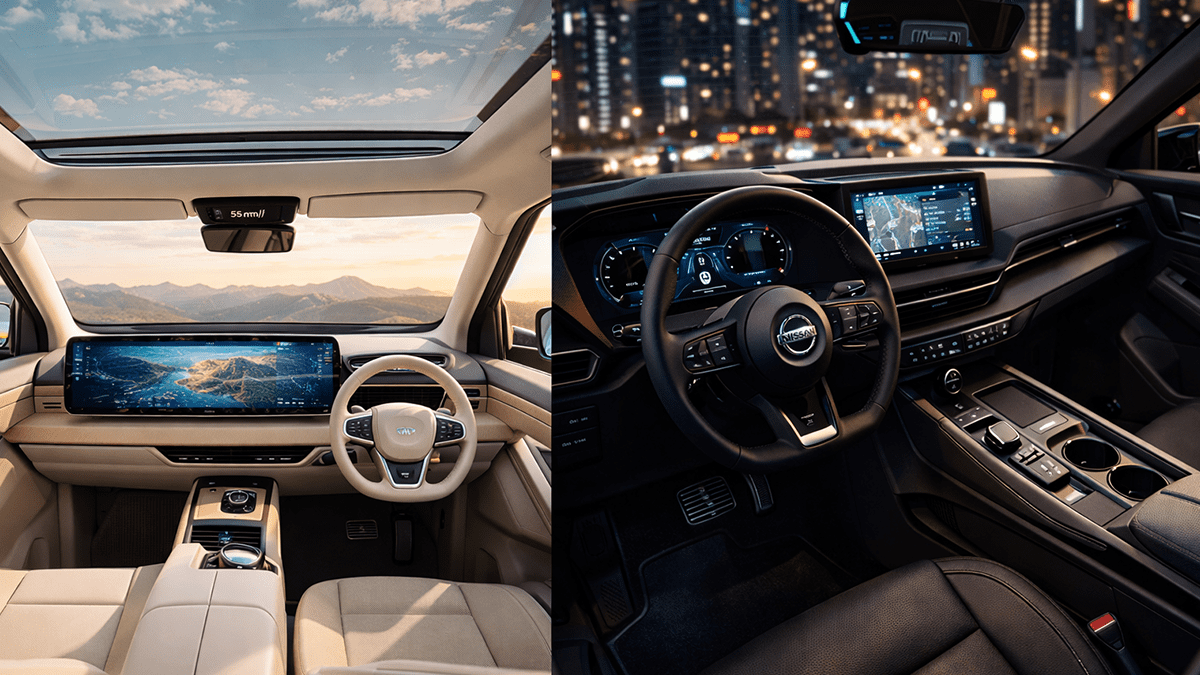
The rear windows curve into the roof, giving rear passengers a panoramic view of the sky. In 2026, this design is still a head-turner.
- The Vibe: Robust. Wide. It looks like an Indian Land Rover Defender.
- The Flex: The “Welcome” animation on the front LED bar makes you feel like Tony Stark every time you unlock it.
- The Risk: It’s wide. Driving this through the narrow lanes of Old Hyderabad or Chandni Chowk requires nerves of steel.
The Nissan Gravite: “I Fit Anywhere”
The Gravite doesn’t scream; it whispers.
It follows Nissan’s “V-Motion” design language—sharp lines, aerodynamic cuts, and a very distinct Japanese grille.
- The Vibe: Athletic. Agile. It looks like it was doing CrossFit while the Sierra was lifting heavy weights.
- The Flex: The “Invisible Hood” technology (cameras showing you exactly what is under the front wheels) makes parking in tight mall spots a breeze.
- The Reality: It blends in. You won’t get people taking selfies with your car at the traffic signal.
Winner: Tata Sierra (for pure Road Presence).
The Interior (Lounge vs. Cockpit)
This is where the philosophies split completely.
The Sierra: A Living Room on Wheels
Tata marketed this as a “Digital Detox” zone, and they weren’t lying.
- The Layout: The rear seats aren’t just a bench; they are “Lounge Seats.” Massive legroom, reclining backrests, and because of that glass roof, it feels airy.
- The Tech: A massive 15-inch screen dominates the dash, but the materials are warm—wood finish, fabric textures. It feels premium, almost luxury.
- The Quirk: Keeping that massive glass roof clean in dusty Indian conditions? Good luck. You will need a dedicated cloth in the glovebox.
The Gravite: A Pilot’s Cockpit
Nissan knows that the driver is the one paying the EMI.
- The Layout: Everything is angled towards the driver. Physical buttons for AC (Thank God!), a heads-up display that actually works in bright sunlight, and seats that use NASA-inspired “Zero Gravity” foam.
- The Utility: Cup holders everywhere. Charging ports for all three rows. A boot that fits four suitcases even with the 3rd row up. It is hyper-practical.
Winner: Nissan Gravite (for Ergonomics) / Tata Sierra (for Vibe).
The Drive (EV Punch vs. Hybrid Efficiency)
In 2026, the powertrain defines the experience.
Tata Sierra (The Electric Bully)
We tested the Long Range EV version.
- Specs: 60kWh Battery, 500km claimed range (Real world: ~380km).
- The Feeling: Heavy but fast. You put your foot down, and the torque pins you to the seat. It eats potholes for breakfast. The suspension is tuned for bad roads, giving it that “Magic Carpet” ride Tata is famous for.
- The Anxiety: Charging infrastructure has improved in 2026, but planning a trip to Spiti Valley still requires math.
Nissan Gravite (The City Slicker)
Nissan brought their e-Power Hybrid tech to the Gravite.
- Specs: A petrol engine that charges a battery, which then drives the wheels.
- The Feeling: It feels like an EV (silent, instant torque) but you fill it with petrol.
- The Mileage: This is the killer feature. 26 kmpl in city traffic.
- The Handling: The steering is light. The turning radius is shockingly small for a 7-seater. You can U-turn this thing on a single lane road.
Winner: Nissan Gravite (for Stress-Free Ownership).
The “Urban Utility” Test
We live in India. We don’t drive on race tracks; we drive in traffic jams and flooded streets.
The Pothole Test:
- Sierra: Ignores them. You feel a thud, but the car doesn’t care.
- Gravite: You feel the road more. It’s stiffer. You slow down for speed bumps.
The Parking Test:
- Sierra: You need the 360-degree camera. It feels like docking a ship.
- Gravite: Effortless. The boxy shape means you know exactly where the car ends.
The “Grandparents” Test (Rear Seat):
- Sierra: Getting in requires a climb (it’s high). But once in, they love the view.
- Gravite: Easy ingress/egress. But the third row is strictly for kids.
The Price & Verdict
Here is the deal breaker.
- Tata Sierra EV: Starts at ₹22 Lakhs. Goes up to ₹28 Lakhs.
- Nissan Gravite: Starts at ₹16 Lakhs. Top model is ₹21 Lakhs.
Who Should Buy the Tata Sierra?
Buy this if you want to make a statement.
If you are the person who loves tech, cares about the environment, and wants a car that feels like a fortress. It is an emotional purchase. You buy it because you love it, flaws and all. It is the “Indian Defender.”
Who Should Buy the Nissan Gravite?
Buy this if you use Excel sheets to plan your life.
If you have a family of 5-6, deal with school runs, grocery hauls, and chaotic city traffic daily. It is reliable, efficient, and respects your wallet. It isn’t sexy, but it works perfectly.
My Personal Pick?
My heart screams Sierra.
But if I’m spending my own money in 2026? I’m taking the Nissan Gravite.
Why? Because in a city like Mumbai or Bangalore, “Peace of Mind” is the ultimate luxury. And nothing beats a Japanese Hybrid for peace of mind.
Frequently Asked Questions (FAQs)
Q: Is the Tata Sierra 2026 available in Petrol/Diesel?
A: Tata has launched a Turbo-Petrol version, but the Sierra was designed as an EV-first platform. The Petrol version compromises on some boot space and doesn’t feel as punchy as the EV.
Q: Does the Nissan Gravite have a sunroof?
A: Yes, the top model gets a panoramic sunroof, but it is not as iconic as the Sierra’s fixed glass edge-to-edge design.
Q: Which car has better resale value?
A: Historically, Japanese cars (Nissan/Toyota) hold value better due to reliability perception. However, the Sierra is a “Cult Car.” If Tata supports it well, it could become a collector’s item, keeping prices high.
Q: Is the Sierra’s glass roof safe in Indian heat?
A: Yes. Tata uses special UV-cut glass that blocks 90% of heat. However, in peak May summer (45°C), you might still want to use the magnetic sunshades provided with the car.
The King is Dead, Long Live the King
The automotive world is boring when everyone makes the same soap-bar shaped SUV.
We should be thankful these two cars exist.
The Sierra proves that Indian design can challenge the world.
The Gravite proves that you don’t need to spend ₹30 Lakhs for a world-class family hauler.
Whichever you pick, one thing is certain: The SUV game in India has never been this good.