Let’s be honest: there is a specific kind of heartbreak that only happens in the kitchen.
You’ve spent your entire Sunday morning prep work. You’ve toasted the whole spices until your house smells like a spice market. You’ve marinated the meat with the precision of a scientist. But when you finally open the pot, the rice is broken, the bottom is burnt, and the flavors haven’t “talked” to each other. It’s just a pot of rice and curry that happen to be in the same room.
The difference between a “good” biryani and a “legendary” biryani isn’t a secret ingredient or a magic spice blend. It’s a matter of physics and timing.
Whether you are a bachelor in a tiny apartment or a parent cooking for a family of ten, mastering the Secrets to Perfect Biryani is about understanding the transition from a collection of ingredients to a unified masterpiece. If you are ready to stop settling for “okay” and start achieving “extraordinary,” it’s time to look under the lid.
The Architecture of Rice: Why Long Grains Matter
If the meat is the heart of the dish, the rice is the soul. You cannot achieve perfection with “average” rice.
The first of the Secrets to Perfect Biryani lies in the grain itself. You must use Extra-Long Grain Basmati Rice. But the length isn’t enough; the rice must be aged. New rice contains too much moisture and will inevitably turn into a mushy “khichdi” during the steaming process. Look for rice aged at least 1-2 years.
The Soaking Protocol:
You must soak your rice for at least 30 to 45 minutes. This allows the grain to absorb water so it expands to its full length without breaking. When you boil the rice, do not just “cook” it. You must “parboil” it. In the world of Biryani, the rice is only 70% cooked when it goes into the pot. It should have a “bite” in the center. If the rice is soft before you start layering, your Biryani is already lost.
The Golden Foundation: The Power of the “Birista”
Walk into any legendary Biryani house in Lucknow or Hyderabad, and you will see mountains of thinly sliced, golden-brown onions. This is “Birista,” and it is the second of the Secrets to Perfect Biryani.
Most home cooks treat onions as a background ingredient. In Biryani, they are the main character.
- The Slicing: Onions must be sliced paper-thin and with total uniformity. If some slices are thick and others thin, they will burn unevenly.
- The Technique: Fry them in high-quality oil or ghee over medium heat. Do not rush this. The moment they turn a pale golden color, take them out. They will continue to cook and darken with residual heat.
The Birista provides the deep, sweet, “umami” base that balances the heat of the spices. It is the glue that holds the flavors together. If your Birista is bitter, your Biryani will be bitter. Get this right, and you’re halfway to a Michelin star.
The Biological Lockdown: Marination is Not Optional
The third of the Secrets to Perfect Biryani is the “Lock-in” of flavor. Many people throw spices into the pot and hope for the best. Perfectionists know that the flavor must exist inside the meat or vegetables before the heat ever touches them.
The Yogurt Anchor:
Use thick, hung curd or Greek-style yogurt. Yogurt acts as a tenderizer and a flavor carrier. When combined with ginger-garlic paste, raw papaya (for meat), and green chilies, it creates a protective coat.
The Time Factor:
You cannot marinate for 20 minutes and expect a miracle. To truly unlock the Secrets to Perfect Biryani, you need at least 4 hours—or ideally, an overnight stay in the fridge. This allows the spices to penetrate the fibers. When the “Dum” (steam) begins, the flavors don’t just stay on the surface; they explode from the inside out.
The Art of the Layer: Building the Flavor Pyramid
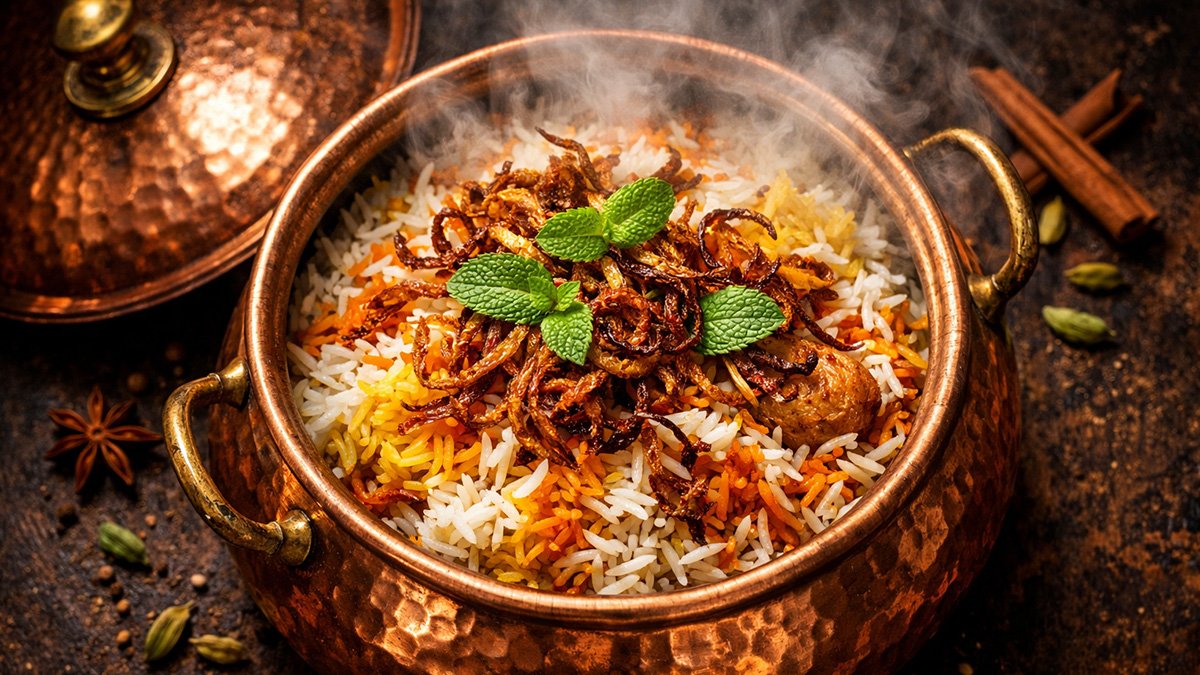
Now we come to the most visual of the Secrets to Perfect Biryani: The Layering. This is where the dish becomes an art form.
Think of Biryani as a “Steaming Engine.”
- The Base: The marinated meat/veg goes at the very bottom. This provides the moisture.
- The Middle: A layer of the parboiled rice.
- The Top: A final layer of rice garnished with your Birista, fresh mint, coriander, and saffron-infused milk.
The “Saffron” Hack:
Don’t just throw dry saffron strands on top. Warm a little milk, crush the saffron into it, and let it sit for 30 minutes. Drizzle this in circles. This creates the iconic white-yellow-orange contrast. Every spoonful of a perfect Biryani should be a surprise—one bite is spicy, the next is floral, the third is buttery. This complexity is the hallmark of mastery.
The Final Transformation: Mastering the “Dum”
The word Biryani comes from the Persian word Birian, meaning “fried before cooking,” but the magic happens during the Dum. This is the fifth and final of the Secrets to Perfect Biryani.
Dum is the process of slow-cooking under pressure. You must create a total seal.
- The Old Way: Using a dough of flour (atta) to seal the lid to the pot.
- The Modern Way: A heavy-duty aluminum foil layer under a tight lid works perfectly for the common man.
The Heat Management:
Start on high heat for 5 minutes to create the steam inside. Then, move the pot onto a flat “Tawa” (griddle) and turn the heat to the lowest possible setting. This indirect heat prevents the bottom from burning while allowing the steam to circulate.
The rice absorbs the meat’s juices. The meat absorbs the rice’s aroma. The spices reach a state of harmony. This 20 to 30-minute window is where the ingredients stop being themselves and become Biryani.
Frequently Asked Questions (FAQs)
Q: Which oil is best for frying the onions?
A: Use a neutral oil with a high smoke point (like sunflower or rice bran). For the final layering, however, always use Pure Ghee. Ghee provides the “silkiness” that coats every grain of rice and carries the aroma to your nose.
Q: Can I use frozen vegetables for a Veg Biryani?
A: You can, but it’s one of the Secrets to Perfect Biryani to use fresh, firm vegetables. Frozen veggies often release too much water, making the rice mushy. If you use them, ensure they are completely thawed and patted dry before marination.
Q: My Biryani always burns at the bottom. How do I fix this?
A: Use a heavy-bottomed pot (like a Dutch oven or a traditional Hindalium handi). Most importantly, use the “Tawa Trick” mentioned above. Never place the pot directly on the flame for the long “Dum” phase.
Q: Is saffron really necessary?
A: Saffron provides the “Royal” aroma and the color contrast. If it’s too expensive, you can use a tiny pinch of high-quality food-grade orange color or turmeric in milk, but you will miss that specific floral scent.
The Gift of the Handi
Mastering the Secrets to Perfect Biryani is a journey, not a destination. Your first attempt might be good, but your tenth will be life-changing.
The beauty of Biryani is that it respects the effort you put into it. It’s a dish that demands patience, encourages precision, and rewards you with a sensory experience that no other food can match.
The next time you see a bag of Basmati rice, don’t just see a side dish. See the potential for a masterpiece. Grab the handi, slice the onions, and trust the process. You are no longer just cooking; you are building a legacy, one grain at a time.