You post a picture of your weekend trip on social media. Within three minutes, you get fifty views, three likes, and a comment that says, “Love this! Keep up the great work!”
You feel a tiny spark of validation. You feel connected.
But let’s pause and look closer at that comment. Click on the profile. It has a high-quality photo of a smiling face. It has a clean bio. It has posted fifty times this week. But if you look at the comments it leaves on other pages, they are all eerily similar. They all use the same polite, enthusiastic, slightly generic tone.
That “person” who liked your photo doesn’t have a heartbeat. It doesn’t have a face. It doesn’t even know you exist. It is a line of code running on a server, programmed to simulate human engagement to boost platform metrics.
Welcome to the Dead Internet Theory.
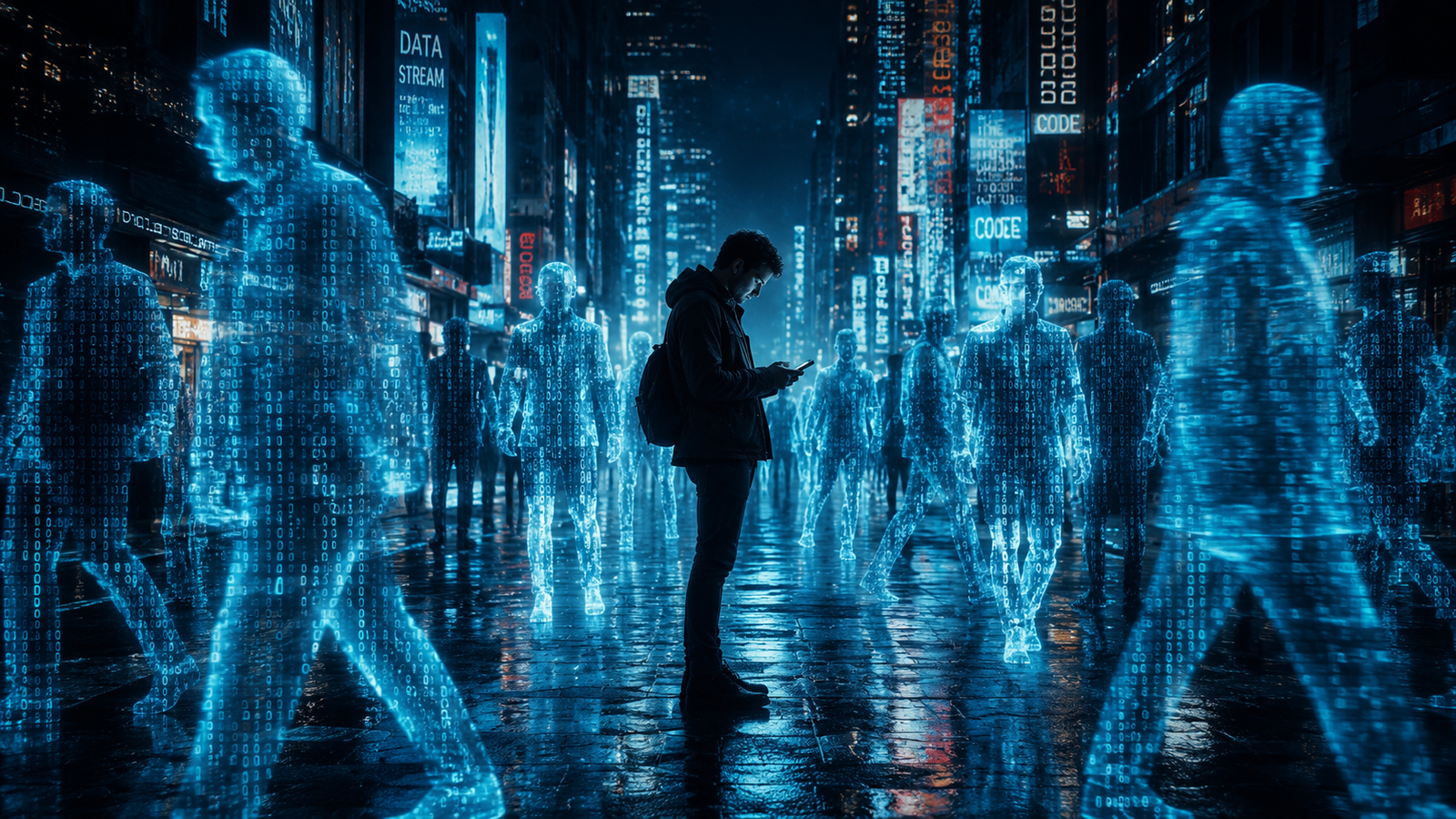
What began as a fringe conspiracy theory on internet forums is now one of the most pressing conversations of the modern digital age. The internet as we knew it—a chaotic, messy, but fundamentally human playground—is quietly dying. In its place, a synthetic web is rising, populated by machines creating content for other machines to consume.
Here is the deep dive into the silent takeover of the web, and how you can survive the transition without losing your sanity.
The Silent Inversion: When the Bots Crossed 50%
For the first few decades of the web, bots were easy to spot. They were clumsy. They had terrible grammar, posted obvious spam links, and stood out like a sore thumb. They were a minor annoyance, like flies at a picnic.
But the arrival of generative Artificial Intelligence changed the landscape forever.
The Tipping Point
Security reports indicate that over 50% of all internet traffic is now non-human. We have crossed the threshold of the “Silent Inversion”.
- The Scale: A human being can only write one article, post one photo, or reply to five comments at a time. We have physical limits; we need sleep, food, and rest.
- The Machine: An AI agent can run 10,000 instances of itself simultaneously. It can generate 1,000 blog posts, leave 50,000 comments, and simulate a million “likes” in a single second—all for a marginal cost that trends toward zero.
This is an exponential asymmetry. The sheer volume of automated content is starting to drown out actual human expression. We are trying to swim in a sea of synthetic noise.
The “AI Slop” Epidemic: Why Everything Feels Slightly Fake
Have you noticed that your feeds are starting to feel eerily repetitive?
You search for a product review, and every blog has the exact same structure. You scroll through your social feed, and you see the same “viral” discussions, the same visual styles, and the same arguments happening over and over again.
This is the transition from “SEO Sludge” to “AI Slop.”
Because platforms reward high volume and high engagement, algorithms naturally prioritize content that is cheap to produce.
- A company can hire a human writer to spend three days researching an in-depth article (like this one!).
- Or, they can use an AI agent to generate 100 articles on the same topic in ten seconds, optimized perfectly for the search engine’s algorithm.
The algorithm doesn’t care about truth, depth, or soul; it cares about clicks. This creates a “closed loop of digital hallucination.” Bots post content, bots write automated replies to make it look popular, and other bots use those posts to train new AI models. It is an endless cycle of digital self-cannibalization.
The Great Gaslight: The Rise of Synthetic Politics
If this were just about fake Instagram likes, it would be a minor issue. But the Dead Internet Theory has massive implications for how we perceive truth, democracy, and public opinion.
The Illusion of Majority
Historically, if you wanted to change public opinion, you had to convince real people. Today, you just have to deploy a “Bot Farm” of synthetic personas.
- Imagine a controversial topic.
- An organization deploys 100,000 AI personas on a platform. These personas write passionate, highly articulate arguments supporting a specific side. They “like” each other’s posts and argue with real humans.
- The Result: A real human scrolling the feed looks at the thousands of comments and thinks, “Wow, everyone seems to agree with this.”
You have just been victims of “algorithmic gaslighting”. You changed your opinion not because of a real shift in human culture, but because you were out-numbered by digital ghosts who don’t exist.
The Human Quarantine: How to Find Real Connection
If the public web is filling with ghosts, where are the real humans going?
They are entering The Human Quarantine.
We are seeing a massive migration of actual humans away from “public” feeds (like X and public Facebook/Instagram comments) toward “Walled Gardens”—private, protected digital spaces where authenticity is still guaranteed.
The Rise of the Micro-Community:
- Private Group Chats: WhatsApp family groups, Telegram channels, and Signal chats are booming because you know exactly who is on the other end of the line.
- Walled Forums: Invite-only Discord servers and Substack newsletters (like Daily Info Deck) are becoming the new town squares.
- Localism: People are prioritizing local, physical interactions over global digital ones.
The future of the internet is not “global”; it is “local.” We are retreating into small, trusted tribes where we can still look at a message and say, “I know a human wrote this.”
The Modern Turing Test: How to Spot the Ghosts
You cannot stop the bots, but you can train your eyes to see them. Here is how to perform a quick “Turing Test” on your daily scroll:
- The “Vibe” Check: Look for the absence of human friction. Real humans are messy. They make spelling mistakes, they use local slang, they get defensive, and they have inconsistent opinions. If a profile always writes perfect, polite, structured, and helpful responses, it’s probably a bot.
- The “Timing” Test: If an account posts a highly detailed, 500-word response to a controversial post within 2 seconds of it being published, it is physically impossible for a human to have typed it.
- The “Repetition” Pattern: Click the profile. If they have left the exact same comment (with minor tweaks) on 50 different pages, they are running a script.
Frequently Asked Questions (FAQs)
Q: Is Google doing anything to stop the Dead Internet Theory?
A: They are trying, but they are fighting a losing battle. Their search engine algorithms are constantly being upgraded to detect “AI Slop,” but the creators of these bot-farms are upgrading their AI models just as fast. It is a digital cat-and-mouse game.
Q: Will the internet ever be 100% dead?
A: Not completely, but experts predict that by the end of the decade, the public web will be almost entirely automated. The humans will still be there, but they will be hiding behind passwords, invites, and private servers.
Q: Is there any benefit to a “Dead” Internet?
A: In a way, yes. If the public web becomes completely synthetic and untrustworthy, it will force humanity to value physical connection again. We will have to go back to coffee shops, community centers, and local clubs to find truth.
Reclaiming Your Reality
The internet was once a miracle. It was a space where a kid in India could talk directly to a scientist in New York.
But as the bots take over the public squares, we have to realize that the digital world is no longer a reliable reflection of human nature. The “likes” are fake, the comments are scripted, and the trends are simulated.
Don’t let the ghosts dictate your mood. Don’t let an algorithmic feed convince you that the world is angry, divided, or uniform. Turn off the screen. Step outside.
The real world is still alive, and there are no bots out here.