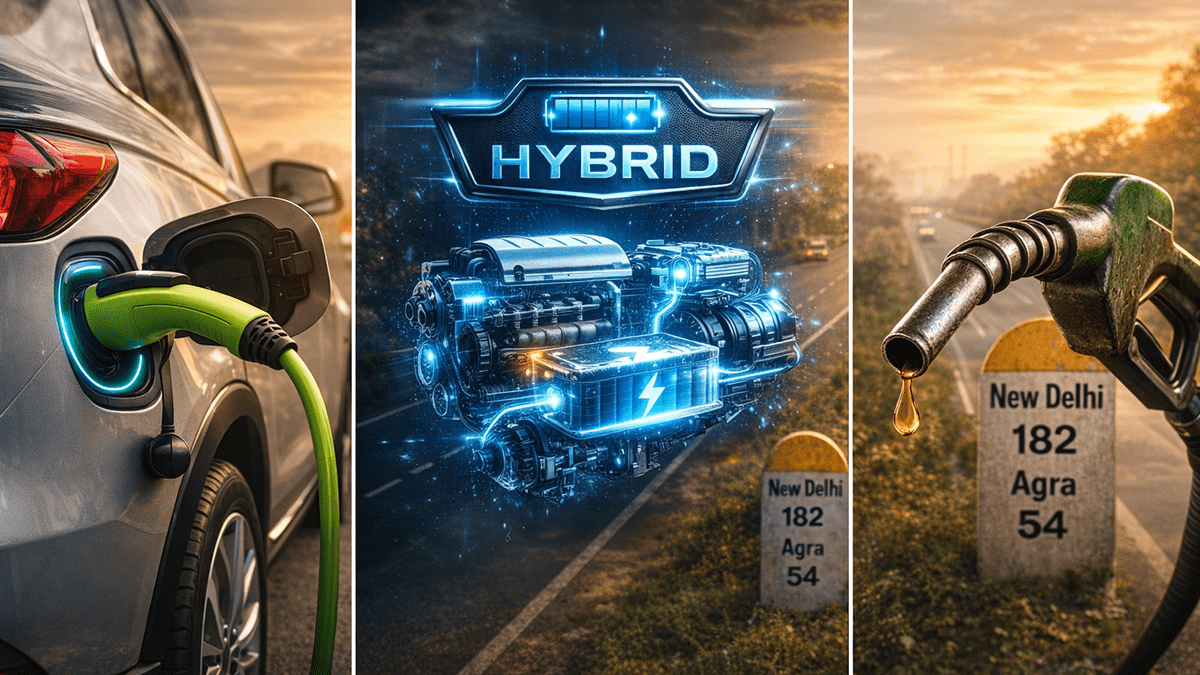
Walk into a car showroom today, and you might feel like you need a Ph.D. in engineering just to pick a model.
Five years ago, you just bought a Swift or a Creta and moved on. Today? You have to choose between ICE (Internal Combustion Engine), EV (Electric), Strong Hybrid, Mild Hybrid, and something called Flex Fuel.
It is confusing. It is expensive. And if you make the wrong choice, you could be stuck with a car that costs you a fortune to run—or worse, one that has zero resale value in 5 years.
So, let’s cut through the marketing brochure nonsense. We aren’t going to talk about “0-100 speeds” or “torque figures.” We are going to talk about Rupees per Kilometer (₹/km).
If you are planning to sign a cheque for ₹15 Lakhs or more this year, read this first.
The Petrol Car (The Old Faithful)
The Contenders: Hyundai Creta, Kia Seltos, Maruti Brezza, Tata Nexon (Petrol variants).
Let’s start with the defending champion. Despite all the noise about green energy, Petrol cars still account for the majority of sales in India in 2026. Why? Because they are simple.
The Good News
- Cheaper Upfront: A petrol SUV is still ₹3-5 Lakhs cheaper than its EV or Hybrid counterpart. That is a lot of money you can keep in the bank (or invest in the stock market).
- Fill It, Shut It, Forget It: You can drive from Kanyakumari to Kashmir without planning. Petrol pumps are everywhere. You never have “Range Anxiety.”
- Service is Easy: Every mechanic in every village knows how to fix a petrol engine.
The Bad News (And it hurts)
- The Fuel Bill: In 2026, with petrol hovering around ₹105 – ₹110 per liter in metro cities, every trip to the pump feels like a robbery.
- Real World City Mileage: 10-12 kmpl (in bumper-to-bumper traffic).
- Cost: Roughly ₹9 to ₹10 per km.
- Resale Value Panic: With the government pushing for green mobility, the resale value of pure petrol cars is slowly dipping. In 2030, will anyone want to buy your used petrol guzzler?
Verdict: Buy Petrol ONLY if your monthly running is low (less than 800 km/month). The money you save upfront pays for the fuel.
The Electric Vehicle (The Tech Bro’s Choice)
The Contenders: Tata Nexon.ev, Mahindra BE.6e, MG ZS EV, Hyundai Creta EV.
In 2026, EVs are no longer “toys.” They are mainstream. The battery tech has improved, and we finally have cars that claim 500km+ range. But is it practical for you?
The Good News (The “Free” Driving)
- Running Cost is a Joke: This is the superpower. Charging an EV at home costs about ₹7-8 per unit of electricity.
- Efficiency: A 40kWh battery gives you ~300km real-world range.
- Cost: Roughly ₹1 to ₹1.50 per km.
- The Math: Driving 1,000 km costs you ₹1,500 in an EV vs. ₹10,000 in a Petrol car. You save ₹8,500 every single month.
- Zero Maintenance: No engine oil, no oil filters, no spark plugs, no gearbox issues. You basically just fill the washer fluid and check the tyres.
- The Drive: Instant torque. No noise. It is the smoothest driving experience money can buy.
The Bad News (The “Charger” Anxiety)
- Highway Reality: While city driving is perfect, long trips (like Mumbai to Goa or Delhi to Manali) still require planning. Fast chargers are there, but if they are broken or occupied, you are stuck waiting for 45 minutes.
- Battery Degradation Fear: The warranty is usually 8 years/1.6 Lakh km. But what happens after that? A replacement battery pack can cost ₹4-6 Lakhs.
- Price Premium: You pay roughly ₹4 Lakhs extra upfront for the battery. It takes about 3-4 years of driving to recover that extra cost through fuel savings.
Verdict: Buy an EV if you have a dedicated parking spot with a charger at home and drive mostly within the city (or planned highway trips). It is the perfect “Second Car” or “City Commuter.”
The Strong Hybrid (The Middle Path)
The Contenders: Maruti Grand Vitara, Toyota Hyryder, Honda City e:HEV.
This is the technology Toyota bet on, and in India, it is winning hearts. A “Strong Hybrid” has both a petrol engine and a small battery/motor. It switches between them automatically.
The Good News (Mileage King)
- Insane Efficiency: In stop-and-go traffic (where petrol cars waste fuel), a Hybrid runs on the battery.
- Real World Mileage: 23 – 28 kmpl.
- Cost: Roughly ₹4 to ₹5 per km.
- No Charging Needed: You never plug it in. The engine charges the battery, and regenerative braking (slowing down) charges it too. It is magic.
- Range: A full tank can easily last 800-900 km. It is the ultimate road trip machine.
The Bad News
- The Tax Problem: The Indian government taxes Hybrids heavily (43% GST + Cess) compared to EVs (5% GST). This makes them expensive to buy.
- Compromised Boot Space: The battery has to go somewhere, and it usually eats up a chunk of your luggage space.
- Complex Tech: You have an engine and a battery and a motor. That is a lot of parts that can go wrong after 10 years.
Verdict: Buy a Hybrid if you have high usage (1,500+ km/month), drive frequently on highways, and don’t have a personal charging spot at home.
The 5-Year Math (Show Me The Money)
Let’s take a real-world scenario.
Imagine you are buying a mid-size SUV (like a Creta/Seltos/Grand Vitara size).
You plan to keep it for 5 Years and drive 15,000 km per year (typical for office commute + weekend trips).
Option A: The Petrol SUV (Cost: ₹15 Lakhs)
- Fuel Bill: (15,000 km x 5 years) / 12 kmpl = 6,250 Liters.
- Cost at ₹105/L: ₹6.5 Lakhs.
- Maintenance: ~₹60,000 over 5 years.
- Total Ownership Cost: ₹15L (Car) + ₹6.5L (Fuel) + ₹0.6L (Service) = ₹22.1 Lakhs.
Option B: The EV SUV (Cost: ₹19 Lakhs)
- Note: You pay ₹4 Lakhs extra upfront.
- Electricity Bill: (75,000 km total).
- Cost at ₹1.5/km: ₹1.1 Lakhs.
- Maintenance: ~₹25,000 (Tyres, Wipers, Fluid).
- Total Ownership Cost: ₹19L (Car) + ₹1.1L (Fuel) + ₹0.25L (Service) = ₹20.35 Lakhs.
Option C: The Strong Hybrid (Cost: ₹18 Lakhs)
- Fuel Bill: (75,000 km) / 24 kmpl.
- Cost at ₹105/L: ₹3.2 Lakhs.
- Maintenance: ~₹70,000 (Complex engine + battery checks).
- Total Ownership Cost: ₹18L (Car) + ₹3.2L (Fuel) + ₹0.7L (Service) = ₹21.9 Lakhs.
The Winner?
Surprisingly, the EV wins by a margin of nearly ₹1.75 Lakhs over 5 years, even though it was the most expensive to buy.
- The Catch: This math only works if you drive more than 1,000 km a month. If you drive less, the Petrol car is actually cheaper overall because you don’t save enough on fuel to cover the high EV price.
The “Resale Value” Trap
This is the scary part. What is your car worth in 2031?
- Petrol Cars: Safe bet, but declining. As E20 (20% Ethanol) fuel becomes standard, older engines might face compatibility issues or lower demand. Expect 50-60% value retention.
- Hybrids: The Gold Standard. Toyota/Maruti hybrids hold value incredibly well because they are reliable and fuel-efficient. Expect 65-70% retention.
- EVs: The Wildcard. Used EV buyers are terrified of one thing: “Is the battery dead?” If battery health is 90%, you get a great price. If it’s 75%, the value crashes. Expect 40-50% retention unless you have a battery warranty certificate.
The “E20 Fuel” Confusion
You might have seen stickers on new cars saying “E20 Compliant.”
By 2026, the Indian government mandates that petrol contains 20% Ethanol (made from sugarcane).
- Why it matters: Ethanol burns differently. If you buy an old used car (pre-2023) that isn’t E20 compliant, the new fuel might corrode the engine parts over time.
- The Advice: If you are buying a new Petrol car in 2026, ensure it is E20 compliant. If you are buying used, be very careful.
Final Verdict: Which Key Should You Pick?
Here is your simple “Cheat Sheet” for 2026:
| If you are… | Buy This… | Why? |
| The City Commuter | Electric Vehicle (EV) | You drive 40km/day in traffic. You have a home charger. You want silence and AC comfort. |
| The Highway Runner | Strong Hybrid | You do inter-city trips (Sales, Travel, Family visits). You hate stopping to charge. You want 25 kmpl. |
| The “Once a Week” Driver | Petrol (ICE) | You work from home. The car is for groceries and Sunday dinner. The low running doesn’t justify the high cost of EV/Hybrid. |
| The Enthusiast | Turbo-Petrol | You don’t care about mileage. You care about the “Vroom.” Enjoy it while it lasts. |
Frequently Asked Questions (FAQs)
Q: How much does it cost to replace an EV battery in India?
A: As of 2026, a replacement battery for a car like the Nexon EV or MG ZS EV costs between ₹4 Lakhs to ₹6 Lakhs. However, most brands offer an 8-year/1,60,000 km warranty, so you likely won’t pay for this out of pocket.
Q: Is “Mild Hybrid” the same as “Strong Hybrid”?
A: No! This is a huge marketing trick.
- Mild Hybrid (e.g., Brezza, Ertiga): Just a tiny battery that helps the AC. Saves maybe 5% fuel.
- Strong Hybrid (e.g., Grand Vitara, City e:HEV): Can drive on pure electric power. Saves 40-50% fuel.
Q: Can I charge an EV in the rain?
A: Yes. EV chargers and cars are IP67 rated (waterproof). You can safely charge your car during the monsoons without getting shocked.
Q: Which car has the best resale value?
A: Currently, Toyotas and Marutis (especially Hybrids) hold their value the best in the Indian used car market.
The “Right” Choice is Personal
There is no “Best Car.” There is only the “Best Car for You.”
If you have a dedicated parking spot and drive to the office daily, the EV is a no-brainer—it’s like getting a salary hike with the money you save.
If you are a road-tripper who loves the mountains, stick to Hybrid or Petrol. The infrastructure isn’t quite there yet for stress-free hill driving in an EV.
Take a test drive. Do your own math. And remember: the most expensive car is the one that sits in your garage because you can’t afford to fill the tank.
Disclaimer
Automobile prices, fuel costs, and electricity rates mentioned are estimates based on market trends in India as of early 2026. Actual on-road prices and running costs may vary by state and driving style. This article does not constitute financial advice.