Let me paint a picture that every Indian middle-class professional knows too well.
It is the 1st of the month. The salary hits your bank account. You feel like a king. You pay your rent, clear the credit card bill, order a nice dinner to celebrate, and think, “This month, I am definitely going to save ₹15,000.”
Fast forward to the 20th of the month.
You check your bank balance. You squint at the screen. You do the mental math.
Where did it all go?
You didn’t buy a Rolex. You didn’t book a flight to Paris. You just lived your life. Yet, somehow, the money evaporated.
In 2026, the biggest financial crisis for the Indian middle class isn’t low income; it is High Frictionless Spending. We have made spending money so incredibly easy that our brains don’t even register that we are losing wealth.
If you are tired of living paycheck to paycheck on a decent salary, standard advice like “make a spreadsheet” won’t work. Here is the psychological truth about how to save money in India, what the “Friction Strategy” is, and how to use it to rebuild your bank balance.
What is the Problem?
To solve a leak, you must find the hole.
Ten years ago, if you wanted to buy a ₹250 coffee, you had to open your wallet, pull out a ₹500 note, hand it over, and wait for the ₹250 change. Your brain registered the physical loss of paper. It hurt a little bit.
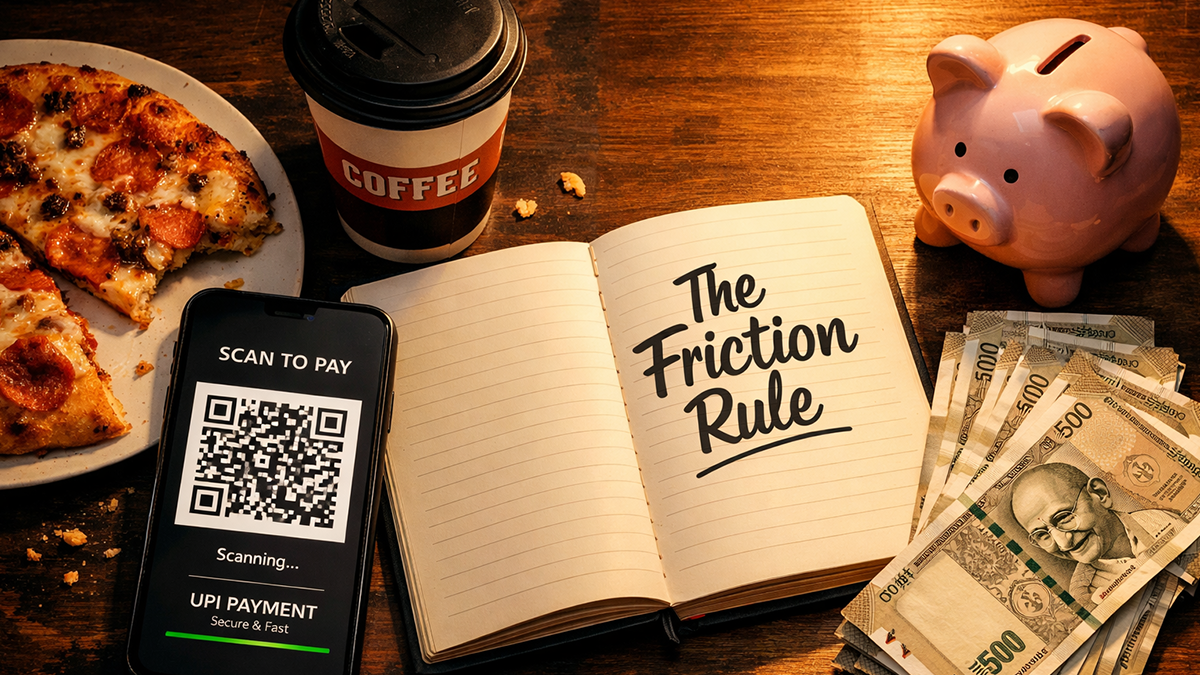
Today, you point your phone at a QR code. A green tick appears. A cheerful sound plays.
It feels like a video game.
This is the “UPI Illusion.” Because there is zero physical friction in the transaction, the pain of spending is completely removed.
You order Blinkit for a ₹60 packet of chips. You pay ₹40 in delivery and platform fees. You don’t care, because it was just a thumbprint.
Add to this the “EMI Trap”. Need a new phone? No Cost EMI. Want a TV? EMI.
Before the month even begins, 60% of your future salary is already pledged to companies you borrowed from.
What is the “Friction Strategy”?
You cannot budget your way out of a behavioral problem. Willpower is a limited resource. If you try to rely on willpower to stop buying snacks at 4 PM in the office, you will fail by Thursday.
The solution is the Friction Strategy.
If technology removed the friction from spending, you must manually add the friction back.
What is it?
It is the deliberate process of making it slightly annoying, difficult, or delayed to spend your money. If a purchase takes 3 seconds, you buy it on emotion. If a purchase takes 3 minutes or 24 hours, you buy it on logic.
What Does It Do For Me?
Applying the Friction Strategy changes your life in three specific ways:
- Cures Impulse Buying: It kills the 11:00 PM Amazon scrolling purchases.
- Forces Prioritization: When it’s harder to spend, you naturally only spend on things that actually bring you joy.
- Builds the “Invisible Corpus”: Without realizing it, the money you didn’t spend on random UPI scans pools up at the end of the month, creating an emergency fund or a vacation budget.
How Do I Use It? (The 4-Step Blueprint)
If you genuinely want to know how to save money in India in 2026, implement these four physical boundaries tonight.
Step 1: The “Delete Saved Cards” Rule
Open Amazon, Swiggy, Zomato, and Myntra right now.
Go to payment settings and delete your saved credit/debit cards.
- Why? When you want to order food, you now have to get up from the couch, find your wallet, pull out the card, and type in the 16-digit number and CVV.
- The Result: Half the time, you will realize you are too lazy to do this, and you will just eat the leftovers in the fridge. Friction wins.
Step 2: The 24-Hour Cart Rule
Have you ever seen a pair of shoes online, added them to the cart, and felt an intense urge to buy them immediately?
- The Rule: You are allowed to buy anything you want, but you must leave it in the cart for 24 hours before hitting checkout.
- The Result: When you wake up the next morning, that intense emotional desire is gone. 80% of the time, you will delete the item from the cart. You just saved ₹3,000.
Step 3: The “Two Bank Account” System (Pay Yourself First)
The middle-class trap is paying everyone else (landlord, Netflix, Apple) and saving whatever is left over. Usually, nothing is left.
- The Hack: Have two bank accounts. Account A is where your salary lands. Account B is a savings account with NO UPI linked to it and NO debit card in your wallet.
- The Action: On the 2nd of every month, set an auto-transfer of 20% of your salary from A to B. It becomes “Invisible Money.” If you don’t see it in your daily UPI account, you won’t spend it.
Step 4: The “Peer Pressure” Audit
In India, we spend a massive amount of money to maintain our image. Going to expensive cafes because colleagues go, or buying expensive gifts for weddings.
- The Hack: Learn the power of saying, “I’m saving up for something big right now, let’s go to a cheaper place or grab chai instead.” True friends will respect it. Anyone who judges you isn’t going to pay your EMIs when you are broke.
The “Guilt-Free” Bucket (Why Diets Fail)
Here is a crucial warning: Do not cut out everything.
If you vow to never eat out, never go to the movies, and never buy clothes, you are putting yourself on a financial “crash diet.”
What happens on a crash diet? You starve for 10 days, and on the 11th day, you eat an entire cake.
If you completely restrict your spending, you will experience “Revenge Spending” next month and blow ₹20,000 in a mall.
Allow yourself a Guilt-Free Bucket.
Allocate 10% of your salary specifically for fun. If you want to blow it all on a fancy dinner, do it. But once that 10% is gone, the fun stops until next month. This prevents the feeling of poverty while maintaining extreme discipline.
Frequently Asked Questions (FAQs)
Q: I have a home loan and car loan. How to save money with high EMIs?
A: If your EMIs exceed 40% of your take-home salary, you are in a danger zone. Your first priority is to stop creating new EMIs (no more phone upgrades). Throw any extra annual bonus or tax refund strictly into prepaying the principal of your highest-interest loan (usually a personal loan or car loan).
Q: Is putting money in a savings account enough?
A: No. In 2026, inflation will eat your savings account money (which gives 3-4% interest). Once your “Account B” reaches a 3-month emergency fund size, start moving the extra savings into an Index Mutual Fund (Nifty 50) to beat inflation.
Q: Should I track every single rupee I spend?
A: Only do this for one month. Doing it forever is exhausting. Track every rupee for 30 days just to see where your “leaks” are (usually Swiggy or subscriptions). Once you plug the leaks, use the “Two Bank Account” system so you don’t have to micromanage daily.
Stop Working for Your Phone
Every time you scan a QR code without thinking, you are trading minutes of your life at work for a fleeting moment of convenience.
You work hard for your ₹50,000, ₹1 Lakh, or ₹2 Lakhs a month. Don’t let an app designed by tech billionaires drain it from you $2 at a time.
Add the friction. Delete the saved cards. Move the money before you can see it.
When you learn how to save money in India by outsmarting your own brain, the anxiety of the 20th of the month disappears forever.
Take back control of your QR code.