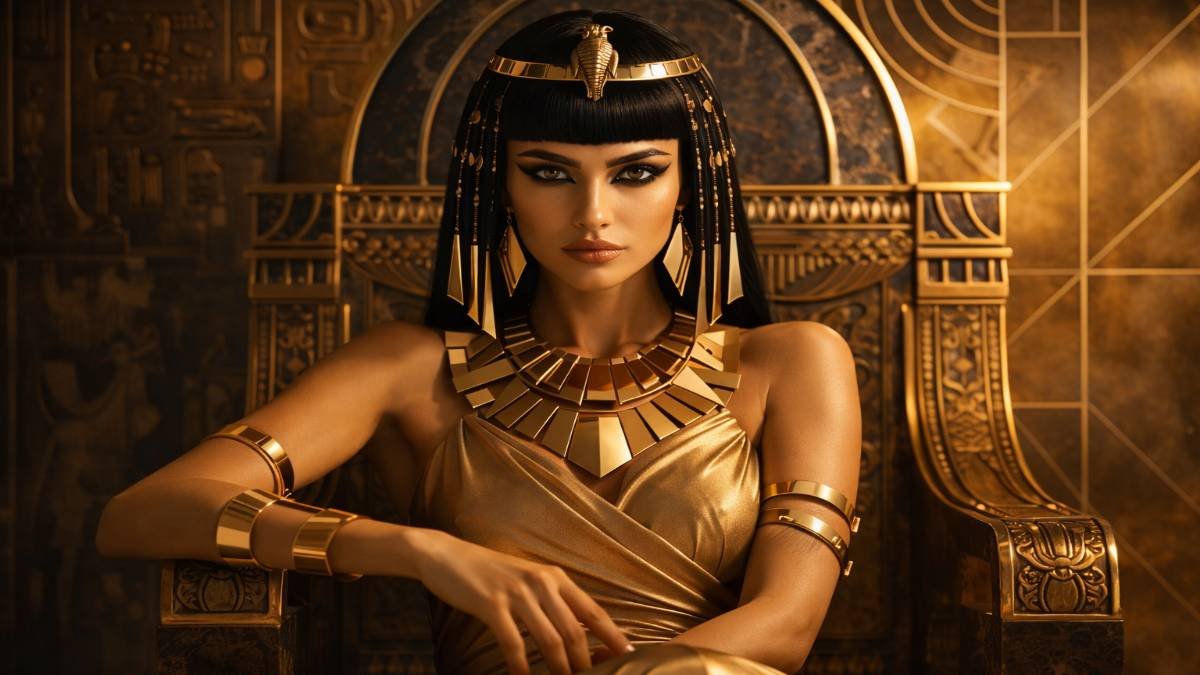
History has a habit of “flattening” its female icons.
For 2,000 years, the narrative about Cleopatra VII has been obsessively focused on her beauty. She is portrayed as a “seductress,” a woman who manipulated powerful men to get what she wanted, as if her entire reign was just a romantic subplot.
But if you look at the actual historical data, this is the biggest PR smear campaign in history. The reality? Cleopatra was a polyglot, a mathematician, a naval commander, and the most effective diplomat of her era. She didn’t just inherit a crumbling empire; she took the richest country on earth—Egypt—and kept it independent while Rome was busy swallowing the rest of the Mediterranean.
In 2026, we value “Personal Branding” and “Soft Power.” Cleopatra invented them. Here is how she did it.
The Brand of the Queen (Marketing Genius)
Caesar understood the power of a headline. Cleopatra understood the power of Visual Branding.
When she visited Rome, she didn’t show up in a simple carriage. She entered the city in a massive, elaborate procession, surrounded by gold, exotic animals, and cultural wonders. She wasn’t just a guest; she was an “Experience.”
The Strategy:
She understood that perception is reality. By curating her image—the clothing, the jewelry, the way she spoke—she transformed herself into a living icon. In modern business terms, she was a master of “High-End Positioning.” She made sure that even when her country was militarily weaker than Rome, she felt like the “senior partner” in every room she entered.
The Lesson:
You are the CEO of your own career. How you present your ideas, how you dress for the boardroom, and how you frame your successes is part of your value. Cleopatra proved that if you act like you are the most important person in the room, everyone else will eventually agree with you.
The Linguist CEO (Soft Power)
Here is a fact that usually surprises people: Cleopatra was the first ruler of the Ptolemaic dynasty (a Greek family that ruled Egypt) to actually bother learning the Egyptian language.
Her predecessors spent 300 years acting like Greek royalty, detached from the local people. Cleopatra realized that to lead, you have to listen. She learned Egyptian, Ethiopian, Troglodyte, Hebrew, Arabic, Syrian, and Persian. She was an absolute polyglot, and she used these languages to conduct diplomacy directly, without needing a translator who could be bribed or coerced by her enemies.
The Lesson:
In a globalized world, language is a bridge. Whether it’s learning the “language” of your clients, the technical jargon of your engineering team, or the cultural nuances of a new international market, the ability to communicate directly is a massive competitive advantage.
The Logistics of the Nile (Economic Power)
Cleopatra’s power wasn’t just in her “charm”; it was in her Supply Chain.
Egypt was the “Breadbasket of the Mediterranean.” It produced the grain that kept Rome from starving. Cleopatra kept a vice-grip on the production and export of this grain. She understood that if you control the calories, you control the politics.
When she navigated the complex economics of her time, she was doing exactly what modern CEOs do: Managing Stakeholders. She balanced the needs of the Egyptian priests, the Roman military, and the local merchants. She was a master of “B2B relationships.” She knew which parts of the economy to protect (the agriculture) and which to leverage for political stability.
The Fatal Flaw (When the Narrative Fails)
Why did she lose?
History tells us she lost because of a bad battle or a broken heart. But historians suggest something more practical: She lost the PR war.
When Caesar died, the Roman narrative shifted. Octavian (the future Augustus) launched a brutal, targeted marketing campaign against her. He painted her as a “foreign witch” who had hypnotized Roman men. He turned the Roman public against her, making it easy to justify a war.
The Lesson:
Even the most brilliant strategist can lose if they lose control of the narrative. In the 2026 digital age, where AI-generated fake news and deepfakes are everywhere, your reputation is your most fragile asset. If you don’t tell your story, someone else will tell it for you—and they will likely tell a version that favors them, not you.
Frequently Asked Questions (FAQs)
Q: Was Cleopatra actually Egyptian?
A: No. She was of Macedonian Greek descent, part of the Ptolemaic dynasty that took over Egypt after Alexander the Great. However, she was the only one in her family who embraced Egyptian culture and spoke the language.
Q: Did she really commit suicide with a snake (asp)?
A: That is the popular legend, but many historians doubt it. The “asp” was a symbol of divine royalty in Egypt. It is more likely she used a fast-acting poison, and the “snake” story was a symbolic narrative created later by historians to add drama to her end.
Q: How does Cleopatra’s leadership style compare to modern CEOs?
A: She was the ultimate “Crisis Manager.” She faced constant threats of coups, invasion, and bankruptcy, yet managed to maintain a thriving economy. Her ability to navigate high-stakes negotiations while maintaining “brand presence” is exactly what modern global CEOs do.
The Myth vs. The Mastermind
Cleopatra VII was not a side character in the lives of Caesar and Antony. She was the protagonist of her own story.
When we look back at the most famous historical personalities, it’s easy to focus on the drama. But the real lesson of Cleopatra is the power of the Intelligent Brand. She used every tool available to her—linguistics, economics, and PR—to defend her home and her people for over 20 years.
She reminds us that in any industry, the “winners” aren’t always the strongest. Often, the winners are the ones who understand how to connect, how to communicate, and how to command the room the moment they step inside.
History has tried to reduce her to a myth. But the truth is much more impressive: She was the smartest person in the room, and she knew exactly how to make sure everyone else knew it too.