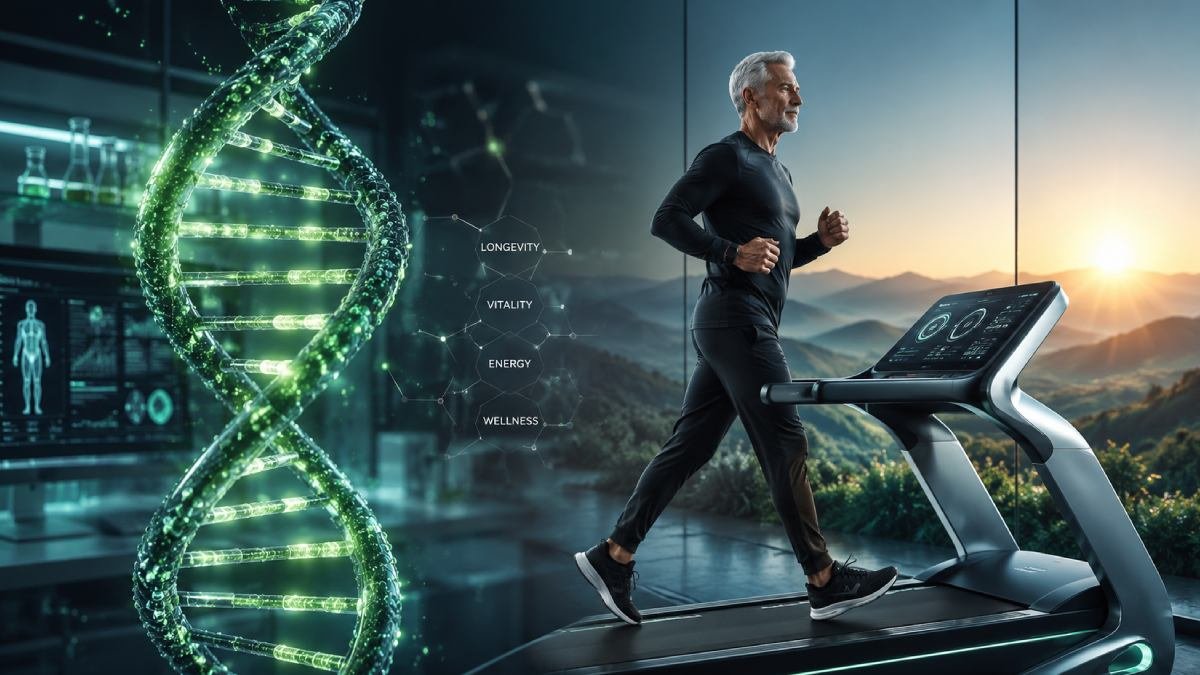
Imagine celebrating your 100th birthday, not in a wheelchair, but on a hiking trail. Imagine having the lung capacity of a thirty-year-old, the joint mobility of a twenty-year-old, and the wisdom of a century.
For generations, we accepted a simple biological timeline: you grow up, you peak, you slowly decline, and by eighty, your body is spent. We viewed aging as a natural, unavoidable law of physics—like gravity or rust.
But a radical shift is happening in the scientific community.
Researchers, neurologists, and geneticists are beginning to look at aging not as a “fact of life,” but as a disease. And like any disease, they believe it can be treated, slowed down, and potentially reversed. The ultimate goal is no longer just “lifespan” (how long you live), but “healthspan” (how long you live healthy).
The race to hack the human code has begun. As billions of dollars pour into anti-aging startups, we have to ask the ultimate question: Can humans live to 120? And more importantly, how much of this futuristic science is available to us right now?
Breaking the Biological Ceiling: The Science of Longevity
Historically, the absolute limit of human lifespan has hovered around 120 years. The oldest verified person to ever live, Jeanne Calment of France, died in 1997 at the age of 122. Since then, no one has breached that wall.
But why do we age in the first place?
Scientists have identified several “Hallmarks of Aging.” One of the biggest is Cellular Senescence. As we age, some of our cells stop dividing but refuse to die. They sit in our tissues like “zombie cells,” secreting toxic chemicals that cause chronic inflammation (the root of almost every modern disease).
Another factor is the shortening of Telomeres—the protective caps at the end of our chromosomes. Think of telomeres like the plastic tips on shoelaces. Every time a cell divides, the lace gets frayed. When the cap is gone, the cell dies.
The Breakthrough:
In labs across the world, scientists are successfully extending the lifespan of mice by 30% to 40% using “senolytic” drugs that hunt and destroy zombie cells. They are using genetic tools to “reprogram” old cells back into their youthful states. The science is moving so fast that what was considered science fiction a decade ago is now entering early human trials.
Wealth Meets Wellness: The Immortality Startups
This scientific shift has caught the attention of the wealthiest people on Earth. In Silicon Valley and beyond, the ultimate status symbol is no longer a super-yacht; it’s a Longevity Protocol.
Companies like Altos Labs (backed by Jeff Bezos) are investing billions into “cellular reprogramming” technology. Their goal is to physically turn back the biological clock of human cells. Meanwhile, tech entrepreneurs are spending millions annually on personal “biohacking” systems—measuring every biomarker, taking dozens of daily supplements, and using low-temperature therapies to keep their biological age years below their chronological age.
This has created a new category of The New Luxury (as we wrote in our lifestyle section). High-end “longevity clinics” are opening up globally, offering full-body MRI scans, genetic testing, and customized therapies that were previously reserved for elite athletes.
But you don’t need a billionaire’s bank account to participate in this race. The core principles of longevity are incredibly simple and accessible to the common man.
The Everyday Blueprint: How to Hack Your Lifespan Today
If you want to know how to live to 120, you have to stop focusing on the “magic pill” and start focusing on the “daily signals” you send to your genes. Here is the low-cost, high-impact blueprint for biological youth.
1. The Power of “Nutrient Scarcity” (Autophagy)
When you eat constantly, your cells are in “growth mode.” They are building new things but never cleaning up the old trash.
- The Hack: Intermittent Fasting or occasional 24-hour fasts.
- The Science: When your cells are “starved” of nutrients for a short period, they trigger a self-cleaning process called Autophagy. They eat their own damaged parts and recycle them, effectively “rebooting” your cellular health.
2. The “Z-Axis” of Fitness (VO2 Max)
If you want to predict how long you will live, look at your VO2 Max (how efficiently your body uses oxygen during intense exercise) and your grip strength.
- The Hack: You don’t need 2 hours of daily gym sessions. You need HIIT (High-Intensity Interval Training) once a week to push your heart rate to its limit, and resistance training twice a week to build muscle density. Muscle is your metabolic shield; lose it, and your biological age skyrockets.
3. The “Cold/Heat” Shock Proteins
Our bodies have evolved to be comfortable, but comfort makes us weak.
- The Hack: Saunas and Cold Plunges.
- The Science: Exposing your body to brief periods of extreme heat or cold triggers the release of Heat Shock Proteins and Cold Shock Proteins. These molecules act like internal mechanics, repairing damaged proteins inside your cells and lowering systemic inflammation.
The “Longevity Drugs” in the Spotlight
While we wait for gene therapy, the medical world is looking at existing, cheap drugs that might hold the secret to anti-aging.
- Metformin: Traditionally a drug for Type 2 diabetes, researchers noticed that patients taking Metformin often lived longer than healthy non-diabetics. It mimics the effects of calorie restriction on a cellular level.
- Rapamycin: An immunosuppressant that, in tiny doses, has been shown to extend the lifespan of every organism it has been tested on.
- NAD+ Boosters: Supplements like NMN or NR that boost NAD+ (a coenzyme critical for cellular energy and DNA repair) which naturally declines as we age.
Always consult a physician before experimenting with prescription drugs for off-label longevity use.
Frequently Asked Questions (FAQs)
Q: Can humans live to 120 without getting chronic diseases like cancer or Alzheimer’s?
A: That is the entire goal of the longevity movement. We aren’t trying to prolong the period of “decrepit old age.” We want to extend the “healthspan.” The goal is to live vibrant, active lives until the very end, followed by a rapid, gentle decline—a concept known as “compression of morbidity.”
Q: Is aging really a disease?
A: While the World Health Organization (WHO) has historically viewed aging as a natural process, there is a massive push to classify it as a disease or a “condition.” This is important because once it is classified as a disease, pharmaceutical companies can get funding and approval to develop drugs specifically to treat it.
Q: What is the single most important habit for longevity?
A: Sleep. During deep sleep, your brain literally flushes out the toxic proteins (like amyloid-beta) associated with Alzheimer’s. If you aren’t sleeping well (refer to our guide on why you feel tired even after 8 hours of sleep), no supplement or biohack can save you.
Conclusion: The Choice of the Century
We are the first generation in human history that has a say in how we age.
The question is no longer just “What did my parents die of?” but “How do I want to live?” The technology to extend our lives is moving faster than our social systems. Within your lifetime, reaching 100 might be as common as reaching 70 is today.
But you don’t have to wait for the future. You can start today.
- Eat less often.
- Lift heavy things.
- Sleep deeply.
- And treat your body like the only home you will ever have.
The longevity race has begun. The finish line is further than you think.
Disclaimer
This article is for informational and educational purposes only. It discusses emerging scientific research, experimental supplements, and lifestyle hacks. This is not medical advice. Always consult a qualified physician or healthcare provider before beginning any new diet, exercise regimen, or supplement protocol, especially if you have existing health conditions.