Imagine you are the CEO of a company that has successfully swallowed every competitor. You are at the absolute peak of your market share. You have more cash, more power, and more control than anyone else in history.
And then, at the very height of your monopoly, you look at the human cost of your victory, and you decide to change your entire business model.
You stop hostile takeovers. You stop aggressive acquisitions. Instead, you dedicate 100% of your resources to employee wellness, community development, and ecological sustainability.
Most business analysts would call you crazy. They would say you’ve lost your edge.
But 2,300 years ago, an Indian emperor did exactly this. His name was Ashoka the Great. He didn’t just rebuild his empire; he built the world’s first genuine welfare state.
At a time when the rest of the world was ruled by the law of the sword, Ashoka ruled by the law of Dhamma (Righteousness). Here is the deep dive into the greatest leadership pivot in human history, and what the “Mauryan Mastermind” can teach you about power, branding, and legacy today.
The Kalinga Epiphany: Breaking the Cycle of Violence
To understand the genius of Ashoka the Great, you have to understand the man he was before he became “Great.”
As a young prince of the Mauryan Empire, Ashoka was known as Chandashoka (Ashoka the Terrible). He was ruthless, brilliant, and obsessed with expansion. He secured his throne by eliminating his rivals and proceeded to launch a series of brutal military campaigns to unify the Indian subcontinent.
The climax of his ambition was the Kalinga War (in modern-day Odisha).
It was a total victory. But as Ashoka walked across the battlefield, he didn’t see glory. He saw 100,000 dead bodies, 150,000 displaced families, and a river running red with human blood.
The Psychological Pivot:
Most conquerors would have celebrated. Caesar did (as we wrote in our Caesar Strategy guide!). But Ashoka suffered a massive crisis of conscience. He realized that “conquest by force” is a hollow victory. This was his “Rubicon” moment, but instead of crossing into further violence, he crossed into introspection. He renounced aggressive warfare forever and embraced Buddhism.
In modern leadership, this is the transition from transactional leadership (forcing compliance) to transformational leadership (inspiring alignment). Ashoka realized that a stable empire cannot be built on fear; it must be built on consent.
The Dhamma Blueprint: Building the First Welfare State
When Ashoka gave up the sword, he didn’t become a weak, passive monk. He remained the Emperor of the largest empire India had ever seen. He simply channeled his immense strategic energy into a new product: The Welfare of His People.
He introduced Dhamma—not as a state religion, but as a civic code of conduct.
The Mauryan “ESG” (Environmental, Social, and Governance) Strategy:
- Medical Infrastructure: Ashoka built the world’s first veterinary and human hospitals, importing medicinal herbs from across the world.
- The Highway Network: He planted trees along roads to provide shade, dug wells every few kilometers, and built rest houses for travelers.
- Animal Rights: He banned the slaughter of certain animals and restricted forest burning—essentially creating the first wildlife conservation laws in history.
Why this matters today:
Ashoka understood that Social Capital is Financial Capital. By building hospitals, roads, and agricultural security, he reduced the internal friction of his empire. Happy, healthy citizens don’t rebel. They trade. They produce. They thrive. It was a masterclass in “Stakeholder Capitalism” long before the term existed.
The Rock Edicts: The Original Content Marketing Campaign
How do you communicate a brand-new corporate policy to 30 million people spread across a subcontinent without the internet, printing presses, or television?
You use The Rock Edicts.
Ashoka carved his laws, his apologies, and his philosophical advice directly into massive cliffs and polished sandstone pillars placed at busy trade routes, pilgrimage sites, and border crossings.
The “Copywriting” Genius of Ashoka:
- The Language of the Masses: He didn’t write in Sanskrit (the language of the elites). He wrote in Prakrit (the language of the common man) using regional scripts like Brahmi and Kharosthi.
- Absolute Transparency: In Edict XIII, he publicly apologizes for the Kalinga War. Imagine a modern world leader writing a public confession on a national monument about their foreign policy mistakes. That level of transparency built an unbreakable bond of trust with his subjects.
- The “Zero-Bravado” Tone: He referred to himself as Devanampiya Piyadasi (Beloved of the Gods, He Who Looks on with Affection). He didn’t call himself “The Great Conqueror.” He positioned himself as a father figure, not a warden.
This was the first successful mass “Content Marketing” campaign in history. He didn’t need soldiers to enforce his laws; the stone pillars did the work of reminding people how to live.
The Soft Power Superpower: Exporting Peace
In the modern world, countries spend billions on “Soft Power”—using culture, cinema, and values to influence other nations instead of weapons.
Ashoka the Great was the father of Soft Power.
Instead of sending armies to Greece, Sri Lanka, and Central Asia, he sent Dhamma Dutasa (Peace Emissaries)—including his own son, Mahendra, and daughter, Sanghamitra. They carried Buddhist philosophy, agricultural techniques, and medical knowledge.
The Result:
While Alexander’s empire collapsed the moment he died, Ashoka’s cultural empire survived for millennia. He turned Buddhism from a local sect in Bihar into a global religion that shapes the minds of over 500 million people today. He proved that ideas are more durable than iron.
Frequently Asked Questions (FAQs)
Q: Did Ashoka disband his army after converting to Buddhism?
A: No. This is a common myth. While Ashoka renounced aggressive war, he maintained a strong standing army to defend his borders and maintain internal peace. He was a pacifist, but he was not naive. He understood that “Soft Power” works best when backed by a strong, silent shield.
Q: What is the significance of the Ashoka Chakra on the Indian flag?
A: The wheel (Chakra) represents the Dharmachakra—the wheel of law and righteousness. It is a symbol of motion, progress, and ethical governance. It was chosen for the national flag to remind modern India of its roots in Ashokan peace and justice.
Q: How did Ashoka manage such a massive empire without modern communication?
A: Through extreme administrative decentralization. He kept a lean central “C-Suite” in Pataliputra (Patna) and appointed regional governors (often princes) to run provinces, giving them the flexibility to adapt to local customs while adhering to the core principles of Dhamma.
The Horizon of the Lions
Empires rise and fall. The Mauryan dynasty eventually collapsed, and the dust of time covered Ashoka’s pillars for nearly two thousand years until British archaeologists deciphered his Brahmi script in the 19th century.
But his legacy never died.
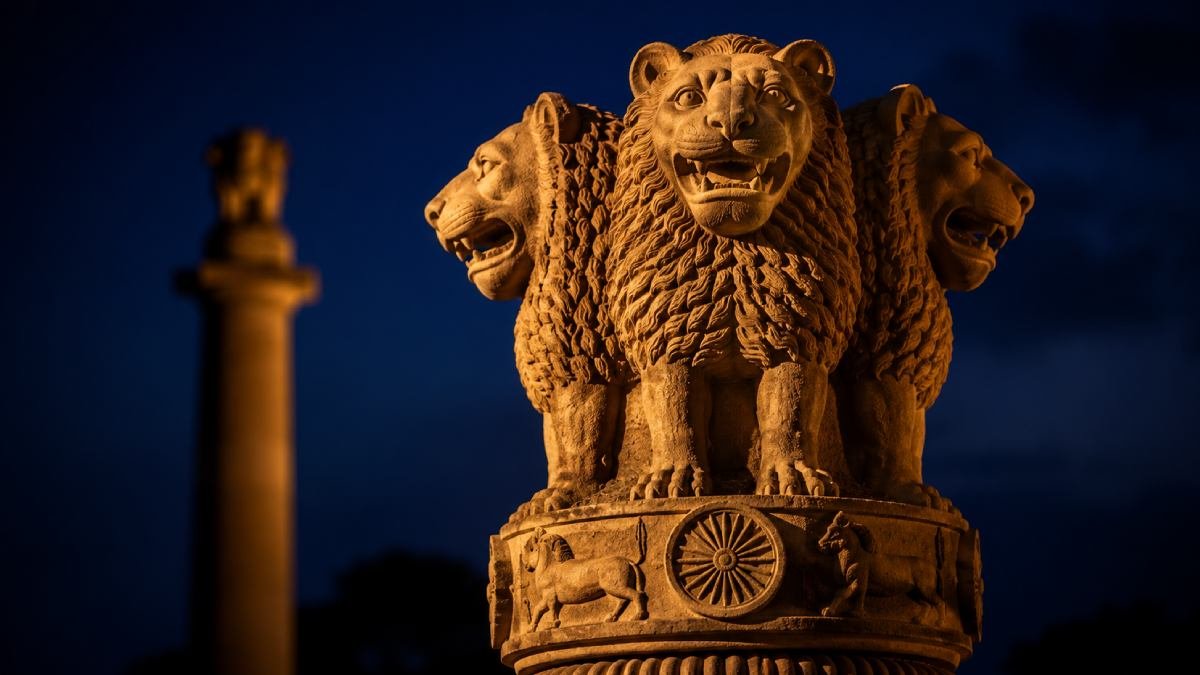
Every time you look at the Indian national emblem—the four lions standing back-to-back—you are looking at Ashoka’s Lions. They were originally built to symbolize the spread of peace in all four directions.
Ashoka the Great proved that the ultimate measure of a leader’s greatness is not how many people they conquered, but how many people they protected. He turned power into service, and in doing so, he became immortal.
The next time you are faced with a choice between “winning by force” or “winning by trust,” remember the Lion Capital.
Real strength doesn’t need to roar. It just needs to stand.