The air over the coast of Ullal was thick with the smell of salt, smoke, and burning oil.
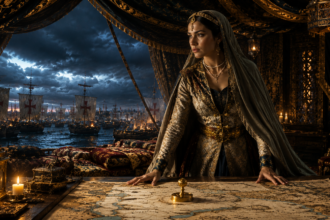
From the stone ramparts of her seaside fort, a young queen watched the dark horizon of the Arabian Sea turn a brilliant, violent orange. Out on the water, a massive Portuguese galleon—a floating fortress of iron and cannon—was burning. Its sails were collapsing into the waves like dying white birds.
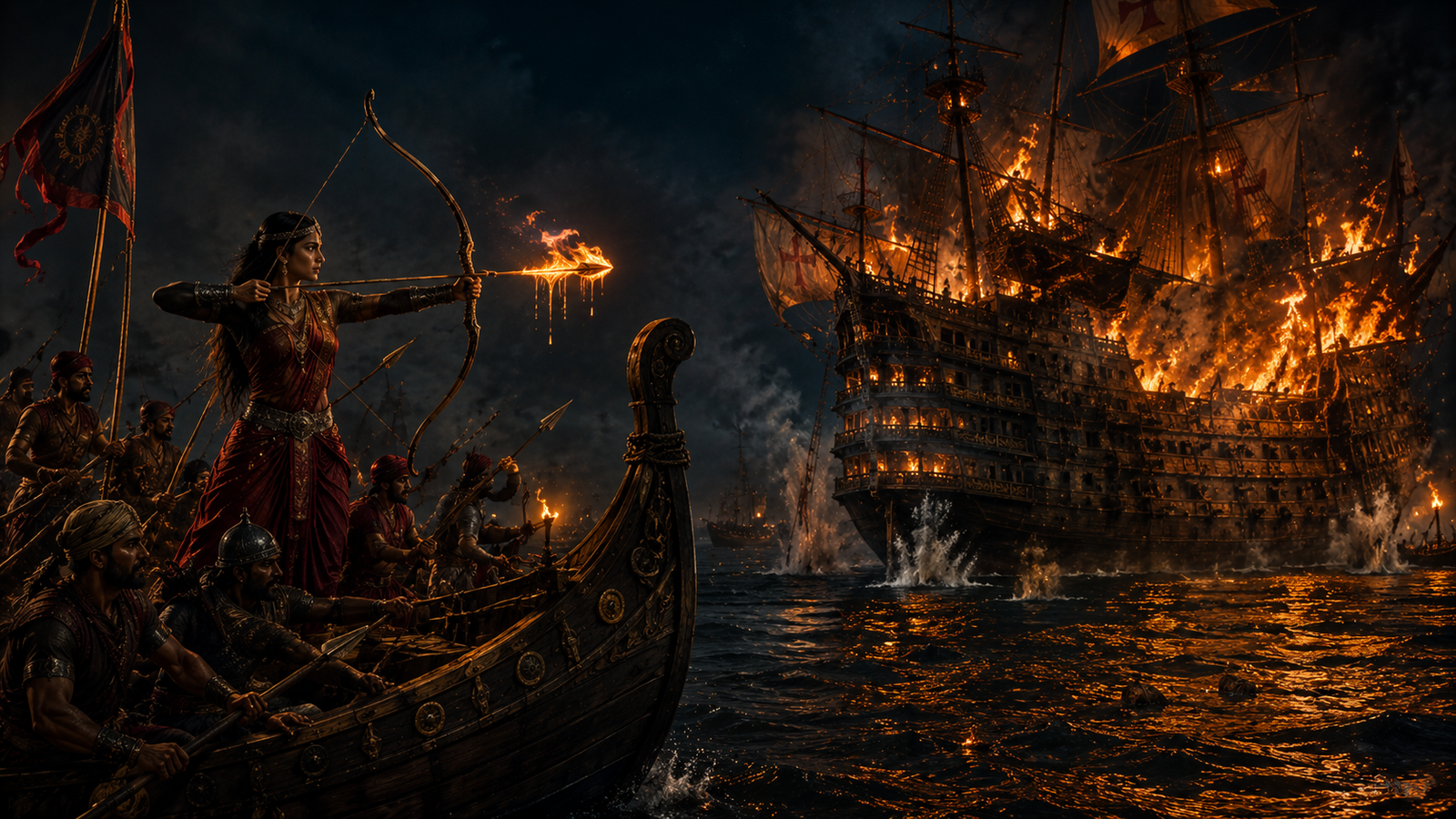
The ship had been destroyed not by another empire’s navy, but by a fleet of tiny, agile wooden fishing boats. Under the cover of pitch-black darkness, local seafarers had rowed silent circles around the giant vessel, launching clay pots filled with boiling coconut oil and flaming arrows directly into the dry canvas sails.
Standing on the shore, sword in hand and her battle sari soaked in sea spray, was the architect of this attack: Rani Abbakka Chowta.
Long before the British East India Company ever established a foothold in India, the Portuguese had already arrived, determined to lock down the global spice trade. They assumed the small kingdoms of the Indian coast would bow to their superior gunpowder. But for over forty years, one tiny port city near modern-day Mangalore stood like a bone in their throat. This is the story of the woman who commanded the seas when the world’s greatest navy tried to take them.
The Matrilineal Throne: Rules of the Coast
To understand the story of Abbakka, you have to understand the land she ruled. She belonged to the Chowta dynasty, which ruled over Tulu Nadu—a rich, fertile strip of coastal Karnataka.
The Chowtas were unique. They followed a matrilineal system of inheritance known as Aliyasantana, where power, property, and the royal line were passed down through the female side of the family. In a world where women were rarely allowed to speak in court, Abbakka was trained from childhood to run an empire.
She was educated in statecraft, diplomacy, military strategy, and martial arts. When she ascended the throne of Ullal in the mid-16th century, she didn’t just inherit a crown; she inherited a target on her back.
The Trade War of Spice and Steel
The Portuguese had captured Goa in 1510. They didn’t just want to trade; they wanted a monopoly. They introduced the Cartaz—a forced shipping permit that every Indian merchant ship had to buy. If an Indian ship carried spices (especially black pepper or ginger) without a Portuguese permit, the cargo was seized, the ship was burned, and the crew was thrown overboard.
Ullal was a highly lucrative port. It was the outlet for the rich spice-growing regions of the Western Ghats.
The Portuguese sent an ultimatum to the young Queen Abbakka: Pay us tribute, buy our permits, and stop trading with the Arab merchants of the Middle East.
Abbakka’s response was a simple, flat No.
She refused to pay a single copper coin. She continued to send her ships loaded with spices directly to Persia and Arabia, bypassing the Portuguese blockade entirely. She knew that to yield even once was to surrender the sovereignty of her people. The Portuguese, furious at being defied by a “petty queen,” decided to teach Ullal a lesson. They sent a massive naval armada under the command of Admiral Don Alvaro da Silveira to crush her.
The Multi-Faith Armada of the West Coast
When the Portuguese warships lined up outside the port of Ullal, they expected a quick surrender. Instead, they faced a defensive system unlike anything they had seen.
Abbakka understood that she could not win a head-on naval battle. Her small ships would be obliterated by the heavy cannons of the European galleons. So, she played the game of Asymmetry.
She built a highly diverse, multi-faith army. Her forces consisted of local Jains, Hindu soldiers, and most importantly, the Mappila Muslims—expert local seafarers and fishermen who knew the temper of the Arabian Sea better than any navigator in Lisbon.
The Fire Arrow Strategy
Instead of fighting during the day, Abbakka struck at night.
She sent out dozens of light, fast-moving boats called Manchuas. These boats could navigate the shallow, treacherous rocky shoals of the coast where the heavy Portuguese ships would get stuck.
Her soldiers used Agnivana—fire arrows wrapped in coconut fibers soaked in resin and oil. They fired these into the rigging and sails of the enemy ships. By the time the Portuguese crew realized they were under attack, the ship was already a floating torch.
Admiral Silveira’s fleet was forced to retreat, leaving behind burning timber and bruised pride. It was the first of many defeats the “Lioness of Ullal” would inflict on the global empire.
The Betrayal at Midnight and the Final Stand
The Portuguese realized they couldn’t defeat Abbakka from the sea. So, they decided to destroy her from the inside.
They approached her estranged husband, the King of neighboring Mangalore, who was jealous of her independent power and territory. He agreed to help them. He gave the Portuguese the exact layout of Ullal’s land defenses, including the secret entrances to the royal fort.
In 1568, the Portuguese launched a massive, coordinated land-and-sea invasion. Led by General Joao Peixoto, their soldiers managed to slip into the city under the cover of a stormy night. They captured the royal palace.
Thinking the battle was won, Peixoto’s soldiers began to celebrate, plundering the town and letting their guard down.
But Abbakka was not done. She had escaped the palace through a secret tunnel and gathered a small force of 200 of her most loyal, elite warriors. In the dead of night, she launched a ferocious, suicidal counter-attack on her own palace.
She personally led the charge, sword in hand. The sleeping, drunken Portuguese soldiers were caught completely off guard. In the chaotic hand-to-hand combat, General Peixoto was killed, and the remaining Portuguese forces fled to their ships in terror. Abbakka had retaken her city within hours of losing it.
Conclusion: The First Flame of Resistance
Rani Abbakka Chowta was eventually captured years later after another betrayal, dying in a stone prison with her hands still reaching for her sword. Her dynasty eventually faded, but her name outlived her kingdom.
History books often begin the story of Indian resistance with the 1857 mutiny or the rise of the East India Company. But three hundred years before those events, a Jain queen on the spice-scented coast of Karnataka proved that the sea didn’t belong to the Europeans.
She is remembered today in the folk songs of Tulu Nadu as the Veer Rani (The Brave Queen). She belongs to a category of famous historical personalities who didn’t fight for glory or territorial expansion, but simply for the right to look at the ocean and say: “This is our water. And you are not welcome here.”
The next time you look at the Arabian Sea, remember the fire arrows of Ullal. The water still remembers her name.