In the winter of 1249, the fate of the Islamic world hung by a thread.
Off the coast of Damietta, Egypt, a massive fleet of French warships carrying the soldiers of the Seventh Crusade had just dropped anchor. At the head of this army was King Louis IX of France—a devout, battle-hardened monarch determined to crush Egypt, march on Jerusalem, and eradicate Islamic rule in the Middle East.
At this exact, terrifying moment, the Ayyubid Sultan of Egypt, as-Salih Ayyub, died in his military camp from complications of a severe leg wound.
If the news of his death leaked, the Egyptian army would have collapsed in panic. The political factions in Cairo would have torn each other apart for the throne, and the Crusaders would have marched into an empty capital.
But the news didn’t leak. Because standing in the royal tent, looking at the body of her dead husband, was a woman who decided to pull off the greatest deception in medieval history.
Her name was Shajar al-Durr. And this is the story of how a kidnapped slave-girl took control of an empire, defeated a global crusade, and became the ultimate ruler of the Nile.
The Girl Who Was Sold as a Pearl
We do not know where she was born, or what her real name was. Historians believe she was of Turkic or Armenian origin, kidnapped from the northern steppes as a young girl and sold into the brutal slave markets of the Levant.
She was eventually bought as a gift for the Sultan’s son, al-Salih Ayyub, who gave her the name Shajar al-Durr, which translates to “Tree of Pearls”.
But Shajar was not just a beautiful ornament. She possessed a sharp, analytical mind. When her master was imprisoned in a desolate desert fortress during a family inheritance dispute, she refused to leave his side. She stayed in his cell, advising him, comforting him, and helping him plan his return.
When al-Salih eventually won the throne of Egypt, he did something unprecedented: he freed her, married her, and made her his most trusted political advisor. He recognized that her intellect was the most powerful weapon in his palace.
The Dead Sultan’s Ghostly Will
When the Sultan died in November 1249, the Crusaders were already marching toward Cairo. Shajar al-Durr knew that exposing his death would mean instant defeat.
She immediately swore her husband’s closest generals—specifically the commander Fakhr ad-Din and the chief eunuch—to absolute secrecy. Together, they launched “The Great Cover-Up.”
- The Royal Boat: Under the cover of darkness, she had the Sultan’s body secretly loaded onto a boat and transported up the Nile to a secluded fortress on Roda Island.
- The Empty Tent: Every morning, servants brought lavish meals into the Sultan’s empty tent. Doctors entered and exited, whispering about the monarch’s “slow recovery.”
- The Forged Decrees: Shajar utilized a cache of blank parchment sheets that the Sultan had pre-signed before his health collapsed. She forged his handwriting to issue daily military orders, pay the soldiers, and appoint officials.
- The Oath: She forced the entire army and government officials to swear an oath of loyalty to the “ill” Sultan and his absent son, Turanshah.
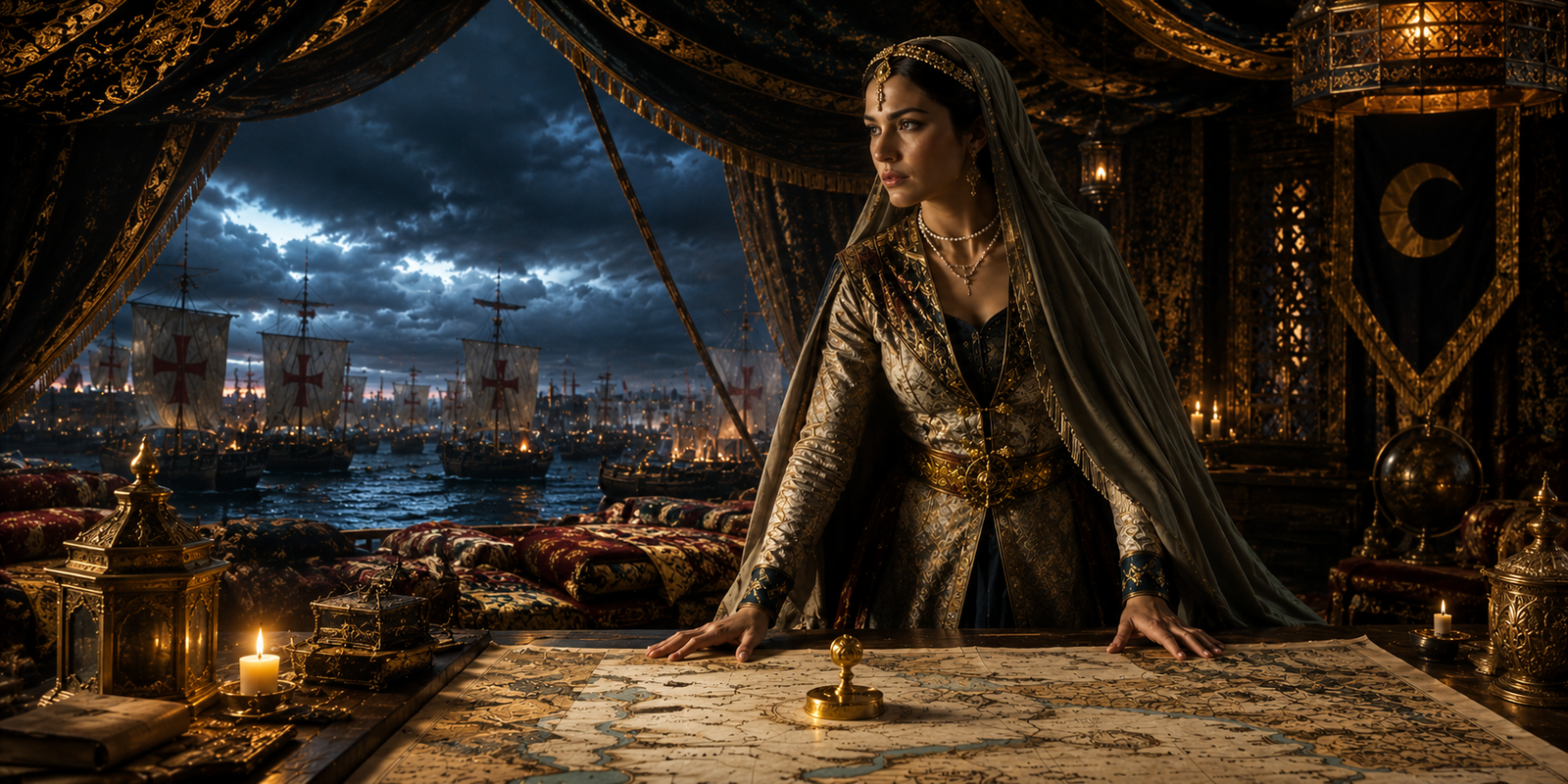
For months, an entire nation, an invading army, and the global intelligence network believed the Sultan of Egypt was simply suffering from a temporary fever. In reality, a former slave-girl was running the war cabinet from a candlelit tent.
The Trap of Mansurah: When a King Became a Captive
The Crusaders, hearing rumors that the Sultan might be dead, decided to strike. Led by the brother of the French King, Robert of Artois, they made a surprise crossing of a Nile canal and launched a ferocious charge directly into the Egyptian military town of Mansurah.
The commander, Fakhr ad-Din, was killed in the initial panic. The road to the town center was wide open.
Shajar al-Durr, now in total control of the forces, agreed to a daring, highly risky counter-strategy proposed by a young Mamluk commander named Baibars.
They did not block the gates of Mansurah. They opened them.
They made the town look abandoned. The French knights, thinking they had won, rode triumphantly into the narrow, winding streets of the city.
Once the entire Crusader cavalry was packed into the tight stone alleys, the trap snapped shut.
Mamluk soldiers poured out of houses, roofs, and side streets. The heavy French cavalry, unable to turn their horses in the narrow spaces, was completely decimated. Robert of Artois was killed.
The main Crusader army was forced into a chaotic retreat. Weakened by disease and starvation, King Louis IX of France was eventually surrounded and captured by Shajar’s forces. The entire Seventh Crusade was stopped dead in its tracks by a queen the world didn’t even know was ruling.
The Friday Sermon of the Slave-Queen
With the Crusade defeated and the King of France sitting in an Egyptian prison waiting for a massive ransom, the Sultan’s real heir, Turanshah, finally arrived in Cairo.
But the new Sultan was arrogant, unstable, and deeply resentful of the power Shajar al-Durr and the Mamluk generals held. He publicly threatened them and demanded she hand over the late Sultan’s treasure.
The Mamluks had seen enough. During a palace banquet, they assassinated Turanshah.
The Ayyubid dynasty, which had ruled Egypt since the days of Saladin, was over. A power vacuum loomed. The battle-hardened Mamluk warriors—the most elite soldiers in the Middle East—gathered to decide who should hold the sovereign power.
They chose Shajar al-Durr.
On May 2, 1250, her name was read aloud in the Friday prayers (Khutbah) at the al-Azhar mosque:
“May God protect the Sultana, the Queen of the Muslims, the Mother of the King Khalil…”
She minted her own gold coins. She was now the absolute ruler of Egypt.
A Palace of Whispers and the Bitter End
But a female ruler in the 13th-century Islamic world was a bridge too far for the conservative Caliph of Baghdad.
Upon hearing the news of her coronation, the Caliph sent a famously sarcastic letter to the nobles of Cairo:
“If you have no men left in Egypt to rule you, let us know, and we will send you one of ours.”
Recognizing the immense political pressure, Shajar al-Durr made a tactical compromise after just 80 days of solo rule. She abdicated the throne and married the chief Mamluk commander, Izz al-Din Aybak, making him the official Sultan while she remained the power behind the scenes.
For seven years, they ruled together. But Aybak grew tired of her shadow. When he attempted to marry a second wife from a rival dynasty to secure his own independent power, Shajar’s reaction was swift and merciless.
She had him strangled in his bath.
It was her final, desperate play for survival. But this time, she had gone too far. Aybak’s loyal soldiers arrested her, and she was handed over to Aybak’s teenage son and his former first wife.
On April 28, 1257, the first female Sultan of Egypt met a brutal end, beaten to death with wooden bath clogs by the palace servants. Her body was thrown into the palace moat.
Conclusion: The Tomb on al-Khalifa Street
Today, tourists in Cairo flock to the Pyramids and the Citadel. But if you walk down the bustling al-Khalifa Street in Historic Cairo, you will find a quiet, domed mausoleum.
Inside, there is a beautifully restored glass mosaic niche (mihrab). It features a single, sparkling golden tree covered in tiny mother-of-pearl leaves.
It is the “Tree of Pearls.”
Shajar al-Durr was erased from many official dynastic lists, but her legacy is carved into the very stone of Cairo. She proved that power doesn’t care about your origins, your gender, or the chains you started with. She took a world of men, turned it on its head, and changed the course of global history.
She was the slave who became a king.