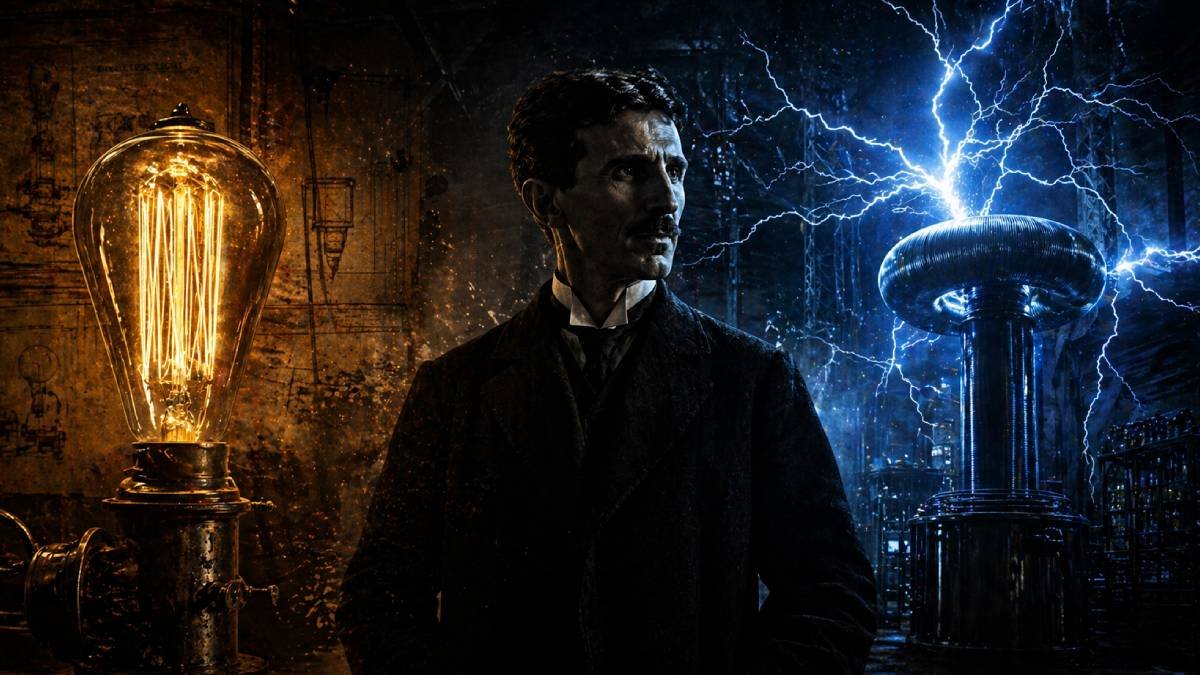
If you were a resident of New York City in the late 1880s, you lived in a world of gaslight and shadows. But a massive shift was coming—a literal “energy revolution” that would transform humanity from a species that slept when the sun went down into one that stayed up all night to build the future.
The battle to power the world wasn’t fought in a quiet lab with noble intentions. It was fought in the boardrooms, the newspapers, and the public squares of Gilded Age America. It was a high-stakes, ruthless, and ultimately transformative business war known today as the War of Currents.
On one side, you had Thomas Edison, the most famous businessman in the world, backed by the mighty J.P. Morgan. On the other, you had Nikola Tesla, a brilliant, eccentric immigrant with a vision for a “World Wireless System.” This is the untold story of why our wall sockets use AC today, and why your career might benefit from understanding the difference between “Edison-style” branding and “Tesla-style” innovation.
The Clash of Philosophies (DC vs. AC)
To understand this battle, you have to understand the technology.
Thomas Edison’s Direct Current (DC) was the status quo. It was safe, simple, and profitable for Edison’s company. However, DC had a fatal flaw: it couldn’t travel long distances. You would need a power plant every two kilometers to keep the lights on in a city. It was an inefficient, localized mess.
Nikola Tesla had a better idea: Alternating Current (AC).
Tesla’s AC could travel hundreds of kilometers over thin wires with almost no loss of power. It was like moving from a dirt road to a super-highway. It was technologically superior in every measurable way. But in the world of high-stakes business, a superior product is rarely enough to win. You also need a superior campaign.
The Original “Smear Campaign”
Edison was a marketing genius long before the term existed. He knew that if the public adopted Tesla’s AC system, he would lose his patent royalties and his grip on the electrical grid.
So, he did what any ruthless businessman would do: He weaponized fear.
Edison embarked on a public relations campaign that would make modern “negative campaigning” look like a nursery rhyme. He toured the country, electrocuting stray animals in public to demonstrate how “dangerous” Tesla’s AC power was. He lobbied the state to use an AC-powered chair for the newly invented electric chair—hoping that if AC became synonymous with execution, the public would reject it for their homes.
This was the first time that “Science” and “Marketing” went to war. Edison wasn’t just selling light; he was selling safety. It was a masterclass in fear-based marketing that nearly killed off the better technology.
The Pivot (How Tesla Won the Future)
If Edison was the “Marketing Guy,” Tesla was the “Deep Thinker.” Tesla didn’t fight back with smear tactics. He fought back with Performance.
In 1893, the Chicago World’s Fair needed to be lit up. Edison demanded a fortune to power it. Tesla offered a fraction of the cost, using his AC system. When the fair opened, 100,000 electric lamps flickered to life—a sight so bright it felt like the sun had been brought down to Earth. The public didn’t care about the rumors or the electrocutions anymore; they cared that the lights worked, were bright, and were finally affordable.
The Lesson:
In business, you can be smeared, you can be misunderstood, and you can be outspent. But if you have a product that fundamentally changes the user experience, you will eventually win. Great engineering is its own form of marketing.
The Tragic Price of Visionary Leadership
So, if Tesla won the War of Currents, why did he die in debt, living in the Hotel New Yorker, talking to pigeons?
The tragedy of Nikola Tesla is that he was a pioneer of “Open Source” in an age of “Patent Locks.”
When the royalties from his AC patents started to pour in, Tesla realized that his licensing fees were making electricity too expensive for the common person. In a move that shocked the business world, he tore up his contracts with George Westinghouse, effectively throwing away a fortune that would have made him the world’s first billionaire.
He didn’t want to be a tycoon. He wanted the world to have free, wireless electricity. He was a visionary who valued the “Global Mission” over the “Quarterly Dividend.” While he is remembered today as the most impactful famous historical personality of the industrial age, he serves as a cautionary tale for any founder: Vision is great, but without a sustainable financial structure, your vision dies with you.
Lessons for the Modern Professional
How do you apply the War of Currents to your life in 2026?
1. Don’t Fight on the Competitor’s Terms
Edison wanted to fight on “safety and fear.” Tesla shifted the terrain to “efficiency and scale.” When you are in a crowded market, don’t try to be “better” at what the competition is doing. Be different. Offer a system, not just a product.
2. The Power of “Systemic Change”
Edison sold lightbulbs. Tesla sold a Grid.
Stop selling “products.” Start selling “ecosystems.” If your service helps your client save time, save money, and improve their life, they aren’t just buying from you—they are plugging into your system.
3. Protect Your Intellectual Property
Tesla was a genius, but he was a terrible protector of his own work. In 2026, whether you are a writer, a dev, or a founder, your intellectual property is your lifeblood. Document your processes, patent your inventions, and value your time. Do not tear up your contracts for “the greater good” until you are wealthy enough to afford that kind of saintliness.
Frequently Asked Questions (FAQs)
Q: Did Edison actually invent anything?
A: Yes. While he was a ruthless businessman, he was also a prolific inventor. The phonograph, the motion picture camera, and the practical incandescent lightbulb are his legacy. He just wasn’t the “only” inventor—he was the one with the best PR team.
Q: Is AC still the standard today?
A: Yes. Everything in your home—your TV, your fridge, your AC—runs on AC power. Your phone and laptop chargers convert that AC into DC, but the “Grid” Tesla fought for is still how the world operates.
Q: How did Tesla’s life end?
A: Tesla died alone in 1943. While he was once a global celebrity, he eventually fell into obscurity. It wasn’t until the late 20th century that the world began to truly appreciate the scale of his inventions.
Q: Are there any lessons for a modern entrepreneur here?
A: Yes. The most important lesson is to balance your idealism with realism. You need to be a “Tesla” (the visionary) but you also need to find a “Westinghouse” (the business partner who can handle the contracts and the money).
Conclusion: The Currents Flow Through You
Every time you charge your laptop, you are participating in a victory that was won in the 1890s.
The War of Currents reminds us that history isn’t just about dates and names; it’s about the struggle to bring a better future into existence. Tesla didn’t just fight for AC power; he fought for a future where electricity would be a utility, not a luxury.
He lost the battle for his personal fortune, but he won the war for the human race. And perhaps, that is the greatest victory any historical personality could hope for.